Children learn about the world largely through seeing, moving, touching, listening and interacting with people around them. When a child has difficulty using visual information effectively, everyday activities such as reading, finding objects, copying from a board, completing puzzles, coordinating both hands or navigating a classroom can become more challenging.
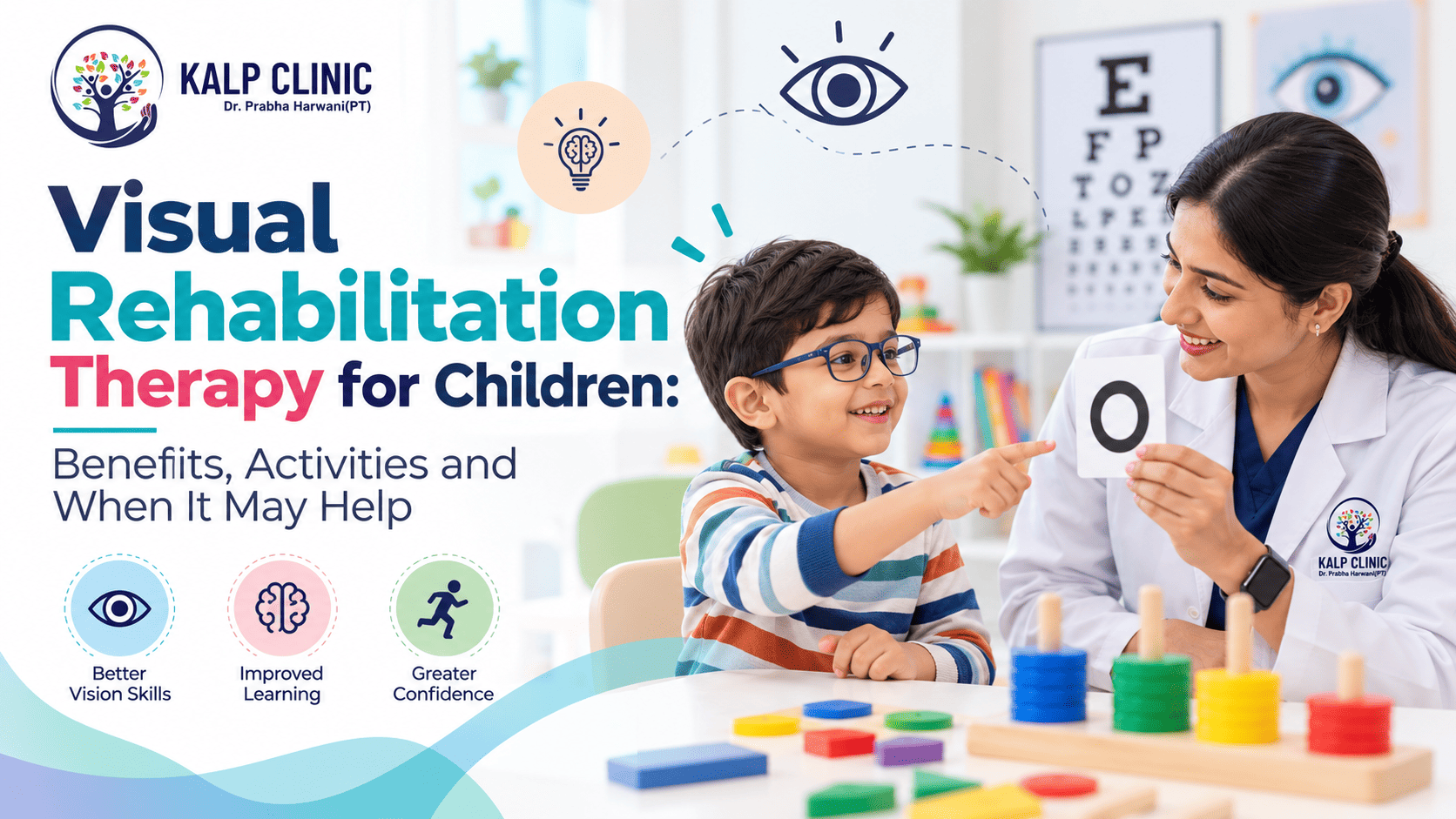
Visual Rehabilitation Therapy is a broad rehabilitation approach that may be considered when a child's visual function or visual information processing affects participation in everyday activities. Depending on the child's needs, support may involve visual skills, visual perception, visual-motor coordination, functional activities and environmental adaptations.
Importantly, visual rehabilitation is not simply about improving eyesight. A child can have apparently adequate visual acuity and still experience difficulties using or interpreting visual information. Current clinical guidance emphasizes that assessment of children's visual function should consider more than visual acuity alone and should be adapted to the child's developmental level and individual circumstances.
For families searching for Visual Rehabilitation Therapy Shyamal, Ahmedabad, Visual Rehabilitation Therapy for children Ahmedabad, or pediatric visual rehabilitation Ahmedabad, understanding what these services involve can be an important first step.
At Kalp Clinic, Shyamal, Ahmedabad, Dr. Prabha Harwani(PT) – Paediatric Therapist supports children and families with individualized developmental and paediatric therapy approaches.
What Is Visual Rehabilitation Therapy?
Visual Rehabilitation Therapy aims to help a child use available visual information more effectively for functional activities.
The exact approach depends on the child's assessment and may address areas such as:
- Visual perception
- Visual attention
- Visual tracking
- Visual scanning
- Eye-hand coordination
- Visual-motor integration
- Spatial awareness
- Visual discrimination
- Functional use of vision
- Coordination during everyday activities
- Adaptation of tasks or environments
Visual rehabilitation can be particularly relevant when visual difficulties occur alongside developmental, neurological or other conditions. Research and clinical guidance increasingly emphasize multidisciplinary assessment because visual function can interact with learning, movement, communication and participation.
Visual Rehabilitation Is Not the Same as an Eye Examination
Parents sometimes use terms such as vision therapy, visual rehabilitation, and eye treatment interchangeably. They are not necessarily the same thing.
An eye examination primarily evaluates ocular health and visual functions such as visual acuity, refraction and other eye-related factors. Rehabilitation may focus on how a child uses available vision during functional activities.
For this reason, children with suspected visual difficulties may need appropriate assessment by eye-care professionals as well as developmental or rehabilitation professionals, depending on the concern.
Understanding Visual Perception in Children
Visual perception therapy focuses on how the brain interprets and makes sense of information received through vision.
A child may be able to see an object but have difficulty interpreting its position, shape, orientation or relationship to other objects.
Visual perception can be involved in activities such as:
- Matching pictures
- Finding an object among several items
- Recognising shapes
- Completing puzzles
- Copying patterns
- Understanding spatial relationships
- Locating information on a page
- Identifying similarities and differences
- Organising objects
- Following visual instructions
Recent guidance on visual information processing disorders describes difficulties involving areas such as visuospatial ability, visual analysis and visuomotor integration, which can affect learning and everyday occupational performance.
What Are Visual Processing Difficulties in Children?
Visual processing difficulties in children can appear in different ways.
Parents or teachers may notice that a child:
- Frequently loses their place while reading.
- Has difficulty finding a particular object in a crowded space.
- Struggles to copy shapes or patterns.
- Finds puzzles unusually difficult.
- Has difficulty recognising objects in unfamiliar environments.
- Avoids drawing or writing activities.
- Has difficulty organising items on a page.
- Struggles with visual instructions.
- Frequently bumps into objects or misjudges space.
- Needs extra time to process visually presented information.
These signs do not automatically mean that a child has a visual processing disorder. Similar behaviours can have many causes, including attention, motor, language, learning, sensory or developmental differences.
A proper assessment is therefore more useful than trying to identify a condition from one or two symptoms.
Visual Tracking Therapy for Children
Visual tracking therapy refers to activities designed around a child's ability to visually follow or locate moving or changing targets.
Tracking can be relevant during activities such as:
- Following a moving toy
- Watching a ball
- Following text while reading
- Moving the eyes between objects
- Searching for items
- Participating in games requiring visual attention
The appropriate activities depend on the child's visual and developmental profile.
Parents should not assume that every child who loses their place while reading automatically needs visual tracking therapy. Reading difficulties can also involve language, attention, learning and other factors.
If tracking concerns are persistent, a professional assessment can help determine what is actually contributing to the difficulty.
Eye-Hand Coordination Therapy
Eye hand coordination therapy focuses on activities where visual information and hand movements need to work together.
Children use eye-hand coordination during many ordinary activities, including:
- Catching and throwing a ball
- Drawing
- Colouring
- Cutting with scissors
- Building blocks
- Completing puzzles
- Buttoning clothes
- Using utensils
- Writing
- Copying shapes
- Placing objects accurately
Activities may be selected according to the child's age and abilities rather than simply repeating the same exercise.
For example, a younger child may practise reaching for and placing objects, while an older child may work on more complex visual-motor tasks related to handwriting, classroom activities or daily living.
Visual Motor Integration Therapy
Visual motor integration therapy addresses activities requiring a child to translate visual information into coordinated motor action.
A child may understand what an object looks like but have difficulty reproducing or manipulating it.
Examples include:
- Copying a simple design
- Drawing within boundaries
- Connecting dots
- Building a structure from a model
- Copying letters or shapes
- Completing construction activities
- Coordinating hand movements with visual targets
Visual-motor skills can have practical relevance to school participation and self-care.
However, therapy should be individualized rather than based on a one-size-fits-all exercise programme.
Who May Benefit From Visual Rehabilitation?
Visual rehabilitation may be considered for children who have identified visual, developmental, neurological or functional difficulties affecting participation.
Depending on the individual situation, rehabilitation may be relevant for children with:
- Developmental delays
- Cerebral visual impairment
- Neurological conditions affecting visual function
- Certain forms of low vision
- Difficulties with visual perception
- Visual-motor challenges
- Developmental disabilities
- Difficulties using vision during everyday activities
Children with developmental delay and vision impairment can have complex needs, and Indian research has emphasized the importance of early intervention, individualized planning and a team-based approach.
For children with visual rehabilitation for developmental delay, the goal should be functional and child-centred: helping the child participate more effectively in activities that matter to their daily life.
Visual Rehabilitation for Autism
Parents may also search for visual rehabilitation for autism when they notice unusual visual behaviours or difficulties involving visual attention, tracking, joint attention or interaction with objects.
Recent research continues to examine visual behaviours in autistic children, including differences in eye tracking, responses to visual stimuli and visual exploration.
However, autism is highly individual. Not every autistic child needs visual rehabilitation, and a visual behaviour does not automatically indicate a visual disorder.
A professional evaluation can help determine whether the child's challenges are related to:
- Visual function
- Visual perception
- Sensory processing
- Attention
- Communication
- Motor coordination
- Environmental demands
- Another developmental factor
The objective should be to identify the child's actual needs rather than applying a therapy simply because a diagnosis is present.
Activities That May Support Visual Skills at Home
Parents can incorporate simple activities into everyday routines. These should be age-appropriate and should not replace professional assessment or therapy when a child has significant difficulties.
1. Matching Games
Ask the child to match:
- Same colours
- Similar shapes
- Identical pictures
- Objects with corresponding pictures
2. Simple Puzzles
Puzzles can encourage visual discrimination, problem-solving and hand coordination.
Start with an appropriate level of difficulty and gradually increase complexity.
3. Ball Activities
Rolling, throwing and catching a ball can combine visual attention with movement.
4. Drawing and Colouring
Drawing simple shapes, colouring within boundaries and copying basic patterns can provide visual-motor practice.
5. Object-Finding Games
Ask your child to find a specific object among several safe and familiar items.
6. Building Activities
Blocks, construction toys and simple models can encourage spatial awareness and coordination.
7. Everyday Visual Tasks
Parents can involve children in:
- Sorting laundry
- Matching socks
- Organising toys
- Finding ingredients
- Putting objects into labelled places
- Following simple picture-based instructions
The benefit comes from meaningful participation, not simply from completing an exercise repeatedly.
Benefits of an Individualized Visual Rehabilitation Approach
A properly planned programme may aim to support functional areas such as:
- Visual attention
- Visual perception
- Eye-hand coordination
- Visual-motor integration
- Participation in play
- Classroom-related activities
- Everyday independence
- Spatial awareness
- Functional use of available vision
For children with low vision, rehabilitation may also include environmental modifications, assistive tools and support from professionals such as ophthalmologists, optometrists, occupational therapists and vision rehabilitation specialists.
Recent research on cerebral visual impairment also emphasizes the importance of coordinated services across healthcare, education and home environments rather than fragmented care.
When Should Parents Seek Professional Assessment?
Parents should consider professional evaluation when visual concerns consistently interfere with daily activities, school participation or development.
Consider discussing concerns with an appropriate professional if your child:
- Frequently struggles to locate objects.
- Has persistent difficulty with visual tasks.
- Avoids drawing, puzzles or visually demanding activities.
- Has difficulty coordinating vision and hand movements.
- Has unexplained difficulties with reading or copying.
- Has known vision impairment.
- Has developmental delay alongside visual concerns.
- Has neurological or developmental conditions affecting visual function.
- Frequently bumps into objects or has unusual difficulty navigating spaces.
- Shows a noticeable change in visual behaviour.
A comprehensive assessment is particularly important because visual function cannot always be understood through visual acuity alone. Current consensus guidance recommends considering multiple aspects of visual function and adapting assessment to the child's developmental level.
Choosing Visual Rehabilitation Therapy in Ahmedabad
Families searching for Visual Rehabilitation Therapy near me, Visual Rehabilitation Therapy Shyamal, Ahmedabad, or pediatric visual rehabilitation Ahmedabad should look beyond a simple service name.
Before beginning therapy, parents can ask:
- What areas of visual function are being assessed?
- What is the child's specific difficulty?
- Is an eye examination required?
- What are the therapy goals?
- How will progress be monitored?
- How will activities relate to the child's daily life?
- How can parents support the programme at home?
- Is coordination with other professionals needed?
For families looking for child development therapy Satellite, Ahmedabad, choosing a centre that considers the child's broader developmental profile can help ensure that visual concerns are not viewed in isolation.
At Kalp Clinic, Shyamal, Ahmedabad, Dr. Prabha Harwani(PT) – Paediatric Therapist and the team take a child-focused approach to developmental and therapy needs.
Families searching for the Best Child Development Center in Shyamal Ahmedabad can consider whether the centre provides individualized assessment, appropriate therapy planning and meaningful parent involvement rather than choosing based only on promotional claims.
The Importance of Parent Involvement
Parents are an important part of any child-development programme.
Therapy sessions may be limited to a few hours each week, while children spend most of their time at home, school and in their community.
Parents can support carryover by:
- Following professional recommendations.
- Practising appropriate activities at home.
- Observing changes in daily performance.
- Sharing concerns with the therapy team.
- Celebrating progress without creating pressure.
- Keeping activities enjoyable and age-appropriate.
A recent 2026 study of children with global developmental delay reported preliminary improvements across several developmental domains following a multi-component intervention that included structured parent training and home-based intervention. This is encouraging but should not be interpreted as evidence that one particular visual therapy works for every child.
Visual Rehabilitation Therapy for children is best understood as an individualized approach to helping children use visual information more effectively for meaningful activities.
It can involve visual perception therapy, visual tracking therapy, eye-hand coordination therapy, visual motor integration therapy and functional activities depending on the child's needs.
Parents should also remember that difficulty with a visual task does not automatically indicate a visual disorder. Children may experience challenges because of developmental, sensory, motor, attention, learning, neurological or eye-related factors. A proper assessment can help identify the underlying needs.
For families searching for Visual Rehabilitation Therapy for children Ahmedabad, child visual rehabilitation Satellite, Ahmedabad, or Visual Rehabilitation Therapy near me, professional guidance can help determine whether rehabilitation is appropriate and what type of support may be useful.
At Kalp Clinic in Shyamal, Ahmedabad, Dr. Prabha Harwani(PT) – Paediatric Therapist supports families with individualized child development and paediatric therapy services.
The goal is not simply to make a child complete visual exercises. The broader objective is to help the child participate, learn, communicate, play and become more independent in everyday life.
Frequently Asked Questions About Visual Rehabilitation Therapy
1. What is Visual Rehabilitation Therapy for children?
Visual Rehabilitation Therapy is an individualized rehabilitation approach that may help children use visual information more effectively during everyday activities. Depending on the child's needs, it may address visual perception, visual attention, visual-motor coordination, tracking and functional skills.
2. What is visual perception therapy?
Visual perception therapy focuses on how children interpret and organize visual information. Activities may involve matching, identifying shapes, spatial relationships, puzzles and other functional visual tasks.
3. What are common visual processing difficulties in children?
Children may experience difficulty with visual attention, locating objects, recognising patterns, copying designs, spatial relationships or organizing visual information. These signs can have different causes, so professional assessment is important.
4. What is visual motor integration therapy?
Visual motor integration therapy involves activities that require children to use visual information to guide coordinated hand movements. Drawing, copying shapes, building and certain classroom activities can involve visual-motor skills.
5. Can Visual Rehabilitation Therapy help children with developmental delay?
Visual rehabilitation may be considered when a child with developmental delay has identified visual or visual-motor difficulties affecting daily activities. The programme should be individualized according to the child's developmental and visual profile.
6. Is Visual Rehabilitation Therapy the same as an eye examination?
No. An eye examination evaluates eye health and visual functions, while rehabilitation focuses on functional use of vision and participation. Some children may need both eye-care assessment and rehabilitation support.
7. Can visual rehabilitation help autistic children?
Some autistic children may have visual or visual-processing concerns, but autism alone does not mean that visual rehabilitation is required. Assessment should identify the child's individual visual, developmental, sensory, communication and functional needs.
8. What activities can parents try at home for visual skills?
Age-appropriate activities may include puzzles, matching games, building blocks, drawing, colouring, ball games, object-finding games and simple sorting activities. Parents should stop an activity if it causes discomfort or frustration and seek professional advice when concerns persist.
9. When should I search for Visual Rehabilitation Therapy near me?
Parents may consider professional assessment when visual difficulties consistently affect reading, learning, play, coordination, navigation, self-care or other everyday activities, particularly when there is an existing developmental or neurological concern.
10. Where can I find Visual Rehabilitation Therapy for children in Shyamal, Ahmedabad?
Families in Shyamal and surrounding areas can explore child development and paediatric therapy support at Kalp Clinic, where Dr. Prabha Harwani(PT) – Paediatric Therapist provides individualized support based on children's developmental needs.