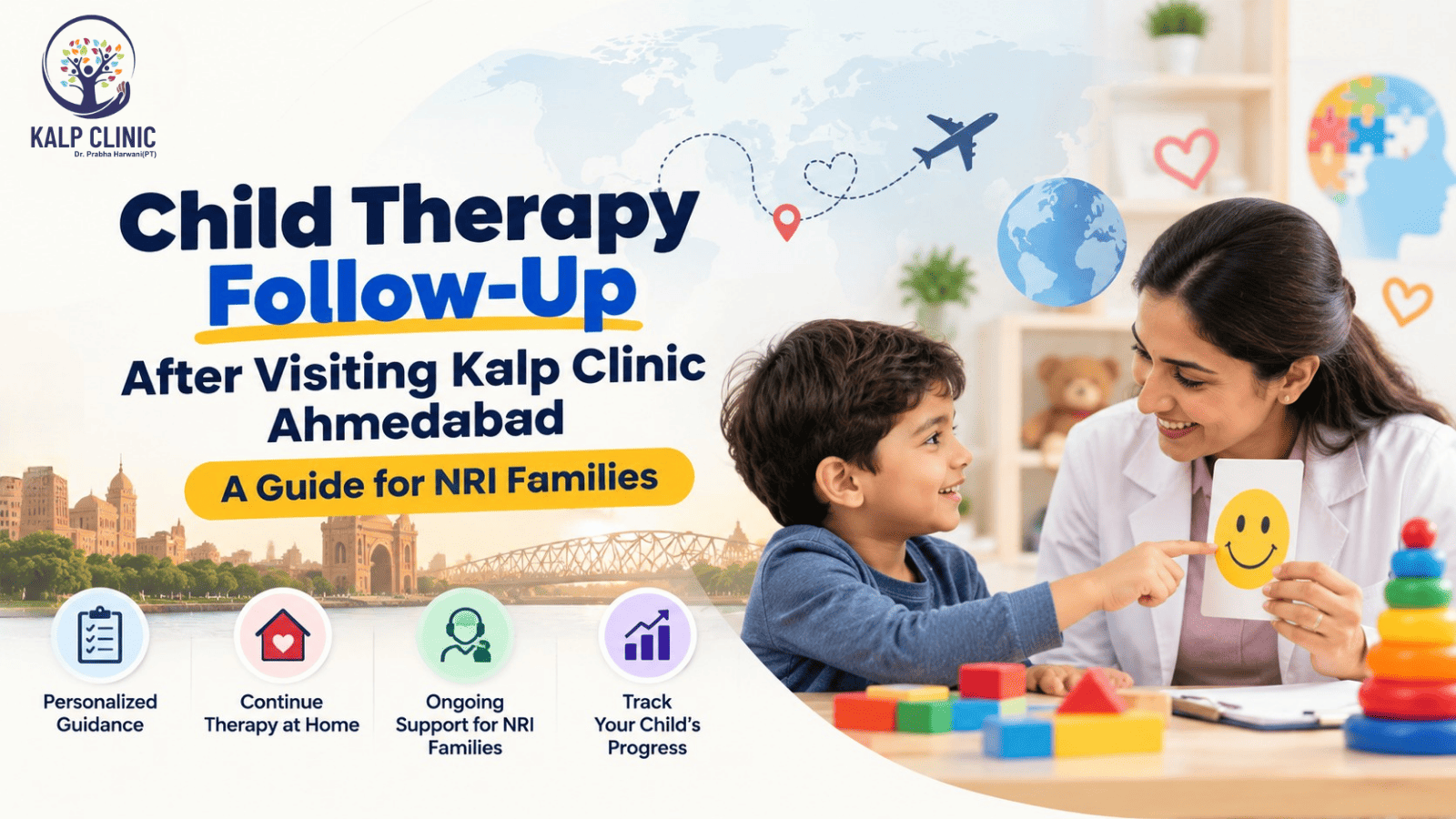
For NRI families who visit India to discuss their child's developmental needs, planning what happens after returning overseas is an important part of the care journey. A consultation can help parents understand their child's needs, discuss professional recommendations and identify possible next steps. However, maintaining continuity after returning home requires organized records, communication with the child's existing healthcare team and realistic goals for ongoing support.
At Kalp Clinic in Shyamal, Ahmedabad, Gujarat, India, parents can enquire about relevant child development and paediatric therapy services with Dr. Prabha Harwani (PT) – Paediatric Therapist. For families travelling from the USA, UK, Canada, Australia, New Zealand, Singapore and other countries, it is useful to consider follow-up arrangements before leaving India.
This guide explains how NRI parents can prepare for child therapy follow-up after visiting Kalp Clinic Ahmedabad, organize developmental records and coordinate appropriate support once they return abroad.
Why Follow-Up Planning Matters for NRI Families
Families sometimes have limited time in Ahmedabad because their visit coincides with holidays, family commitments or other travel plans. They may use this opportunity to seek professional guidance about speech and communication, movement, developmental progress, behaviour or everyday activities.
The next challenge begins after the family returns to its country of residence. Parents may need to share recommendations with a local therapist, discuss the child's progress with a paediatrician or arrange suitable support through their child's school.
A clear follow-up plan can help families:
-
Keep assessment reports and recommendations organized.
-
Explain the child's needs to professionals in another country.
-
Understand which goals should be prioritized.
-
Maintain appropriate activities recommended by the treating professional.
-
Track changes in the child's functional abilities and participation.
-
Identify when a new assessment or professional review may be necessary.
Child therapy follow-up for NRI families should be understood as a coordinated process rather than an expectation that one consultation will resolve every concern.
1. Discuss the Follow-Up Plan Before Leaving Ahmedabad
Before travelling back overseas, parents should clarify what they have learned during their visit and what steps they should consider next.
A useful discussion with the treating professional may include:
-
The main concerns identified during the consultation.
-
The child's current strengths and areas requiring support.
-
Recommendations for further assessment, if needed.
-
Suggested developmental or functional goals.
-
Activities that parents can appropriately practise at home.
-
Whether another in-person review is recommended.
-
Which types of local professionals may be suitable for ongoing support.
Parents should also ask how to contact the clinic for administrative questions about reports or records.
At Kalp Clinic, families can enquire about the available services, documentation and any possible follow-up arrangements. Availability, appointment options and the suitability of individual services should be confirmed directly with the clinic.
The objective is to leave Ahmedabad with a clear understanding of the next steps, rather than a collection of instructions that may be difficult to follow later.
2. Keep Your Child's Therapy Reports and Developmental Records Organized
Organized records are particularly valuable when a child receives guidance in one country and continues care in another. They help parents communicate relevant information without relying entirely on memory.
Create a digital folder containing the documents relevant to your child's care.
Consider including:
-
Assessment reports and consultation notes.
-
Previous speech, occupational or physiotherapy reports, where applicable.
-
Relevant medical history and developmental milestones.
-
Recommendations provided during the visit.
-
Information about activities or goals discussed with the professional.
-
Questions that remain unanswered.
-
Details of any planned reassessment or referral.
Use clear filenames, such as Child_Assessment_October or Therapy_Recommendations, and keep a backup in a secure location.
Parents should check that documents are readable and complete before sharing them. Sensitive information should only be sent through appropriate channels to authorized professionals, with the necessary consent.
When returning to the USA, UK, Canada, Australia, New Zealand or Singapore, parents can share relevant records with their child's local healthcare or therapy team. The receiving professional can then decide which information is useful and whether additional assessment is necessary.
3. Coordinate With Your Child's Existing Therapist Abroad
If your child already receives therapy overseas, explain that you consulted a paediatric therapist during your India visit. Share the relevant report and discuss how the recommendations relate to the child's existing care plan.
This is especially important when the child has established goals for communication, mobility, coordination, daily living skills, behaviour or learning.
Parents can ask the overseas professional:
-
Are the recommendations relevant to my child's current goals?
-
Should any existing activities be continued, modified or paused?
-
Do we need an updated assessment?
-
Which skills should we monitor over the next few weeks?
-
How should progress be recorded?
-
When should we schedule the next review?
The purpose is to support communication between professionals, not to replace the child's established care team or automatically change an existing treatment plan.
Continuity of care for children works best when parents and professionals understand each other's recommendations and agree on appropriate next steps. Healthcare guidance also emphasizes timely information exchange and coordination when children move between services.
4. Set Realistic Goals After Returning Home
Parents may hope to see quick changes after consulting a specialist, particularly if they have travelled a long distance for an appointment. However, developmental progress varies from child to child.
A short visit may help identify concerns, discuss priorities or clarify the need for further assessment. It should not be treated as a guarantee of a particular outcome.
Instead, focus on manageable goals that are appropriate for your child's individual needs.
Examples may include:
-
Practising a communication activity recommended by the child's therapist.
-
Encouraging participation in an age-appropriate daily routine.
-
Supporting a movement or coordination goal when advised by a qualified professional.
-
Helping the child participate in familiar play and learning activities.
-
Recording observations about skills that are improving or remain difficult.
Avoid introducing numerous new activities at once. Parents should understand the purpose of each recommendation and ask for clarification if instructions are unclear.
If an activity causes pain, significant distress or an unexpected change in the child's condition, stop and seek appropriate professional advice.
5. Monitor Progress Without Putting Pressure on Your Child
Child development progress monitoring can help families recognize meaningful changes over time. It does not need to involve complicated charts or daily testing.
Parents can maintain a simple weekly record of relevant observations.
Depending on the child's needs, this may include:
-
Communication attempts and responses.
-
Participation in everyday activities.
-
Changes in movement or coordination.
-
Ability to follow familiar routines.
-
Interaction during play or family activities.
-
Difficulties that occur repeatedly.
-
Activities the child enjoys or finds challenging.
Record examples rather than making broad judgments. For example, describe when a child independently completes a familiar activity instead of simply writing that the child has improved.
Use the information to discuss progress with the child's treating professional. A short video may sometimes help illustrate a functional concern, but parents should only record and share videos when appropriate, protect the child's privacy and follow professional guidance.
Progress tracking is intended to inform care, not create pressure or compare a child with siblings or other children.
6. Understand the Role of Digital Records and Telehealth
Digital health records and telehealth consultations are increasingly relevant to families who live far from a service provider. They may make it easier to share information, ask certain follow-up questions or coordinate care when an appropriate service is available.
However, online child therapy follow-up is not automatically suitable for every child or every concern.
The appropriate format depends on the child's needs, the purpose of the consultation, the professional's assessment and applicable rules in the countries involved.
Before assuming that a remote consultation is possible, ask:
-
Does the clinic offer remote follow-up appointments?
-
Is the service appropriate for the child's particular needs?
-
What records or information should be submitted beforehand?
-
Which communication platform is used?
-
How are privacy and confidentiality addressed?
-
Are there any limitations because the child is located overseas?
Kalp Clinic's availability of online consultations or international follow-up should be confirmed directly. Families should not assume that these services are offered unless the clinic confirms them.
When remote care is appropriate, it should complement—not automatically replace—necessary in-person assessment or the child's local healthcare services.
7. Coordinate Therapy Goals With School and Everyday Routines
Children spend much of their time at home, in childcare settings or at school. Where relevant and with appropriate consent, communication between parents, educators and healthcare or therapy professionals can help make recommendations more practical.
For example, a family may want to discuss how to support participation in classroom routines, communication during daily activities or independence with age-appropriate tasks.
Parents can ask their child's local team whether particular recommendations should be shared with teachers or other caregivers.
Useful steps include:
-
Identifying one or two relevant goals to discuss.
-
Explaining the strategies recommended by the child's professional.
-
Asking which adjustments are appropriate in the school setting.
-
Reviewing progress after an agreed period.
-
Updating the plan when the child's needs change.
Not every clinical detail needs to be shared with a school. Share only appropriate information with the relevant people and respect the child's privacy.
The aim is to help the child participate more comfortably in everyday life while keeping expectations realistic.
8. Know When Your Child May Need Another Assessment
A previous consultation provides information about the child at a particular point in time. It does not mean that every future concern has been addressed.
A fresh assessment may be appropriate if parents or the child's local professional notice:
-
New developmental or functional concerns.
-
Persistent difficulties that affect daily activities.
-
Limited progress despite following an agreed plan.
-
A significant change in communication, movement or behaviour.
-
A need to review goals as the child grows.
-
Conflicting recommendations from different professionals.
Parents should discuss these concerns with an appropriately qualified local healthcare professional. They should not delay urgent local medical care while waiting for advice from a clinic in another country.
When seeking reassessment, bring previous reports and a short summary of what has changed. This can help the professional understand the child's history and decide what evaluation is needed.
9. How Kalp Clinic Can Fit Into Your Child's Care Journey
For NRI parents visiting Ahmedabad, a consultation at Kalp Clinic may be an opportunity to discuss relevant developmental concerns with Dr. Prabha Harwani (PT) – Paediatric Therapist.
The most appropriate next steps depend on the child's needs and the services available at the time of enquiry.
Before making an appointment, parents can ask about:
-
Available consultation options.
-
Documents to bring to the appointment.
-
Whether previous reports can be reviewed.
-
The expected purpose and format of the consultation.
-
Documentation that may be provided.
-
Whether any follow-up arrangements are available.
Kalp Clinic is located in Shyamal, Ahmedabad, Gujarat, India. NRI families can visit the website at www.kalpclinics.com to learn more about the clinic and enquire about relevant services.
A planned approach can help parents make better use of their time in India while preparing for continued support after returning abroad.
10. NRI Parents' Checklist for Child Therapy Follow-Up
Before leaving Ahmedabad:
-
Discuss recommendations and next steps with the treating professional.
-
Ask which reports or consultation notes will be available.
-
Clarify any recommended activities and how to perform them safely.
-
Ask whether another assessment or referral may be needed.
-
Confirm whether the clinic offers any follow-up arrangements.
After returning overseas:
-
Store reports securely in an organized digital folder.
-
Share relevant information with the child's existing professional team.
-
Agree on practical goals for the next stage of care.
-
Record observations about the child's everyday functioning.
-
Review progress at an appropriate time.
-
Seek local professional advice if new concerns arise.
This checklist can help families maintain a clearer record of their child's care across countries without assuming that the same treatment plan will suit every setting.
For NRI families, child therapy follow-up after visiting India involves more than keeping a consultation report. It means understanding recommendations, organizing records, communicating with the child's existing healthcare team and supporting realistic goals after returning home.
A visit to Kalp Clinic in Shyamal, Ahmedabad, may help families discuss their child's needs with Dr. Prabha Harwani (PT) – Paediatric Therapist and clarify appropriate next steps, depending on the services available and the child's individual circumstances.
Whether your family lives in the USA, UK, Canada, Australia, New Zealand, Singapore or another country, thoughtful planning can make it easier to share information and coordinate appropriate care. Contact Kalp Clinic through www.kalpclinics.com to enquire about available services and appointment arrangements.
Frequently Asked Questions
1. What should NRI parents do after visiting Kalp Clinic Ahmedabad?
Parents should organize the available consultation records, understand the recommendations, and discuss relevant next steps with the child's existing healthcare or therapy team. The follow-up plan should reflect the child's individual needs.
2. Can my child continue therapy after we return to the USA, UK, Canada or Australia?
In many cases, families can explore continuing appropriate support through qualified professionals in their country of residence. The specific plan depends on the child's needs, local service availability and recommendations from the treating professionals.
3. Which documents should parents keep after a child therapy consultation?
Keep relevant assessment reports, consultation notes, developmental history, previous therapy records and written recommendations. Share information securely and only with appropriate professionals.
4. Does Kalp Clinic provide online child therapy follow-up for NRI families?
Families should contact Kalp Clinic directly to confirm whether online consultations or remote follow-up are available. Suitability also depends on the child's needs and the type of assessment or support required.
5. Can a therapist in India coordinate with my child's therapist overseas?
Parents can ask both professionals whether communication or information sharing is possible and appropriate. Any exchange should follow applicable privacy requirements and obtain the necessary consent.
6. How can parents track child development progress after returning abroad?
Parents can record simple observations about relevant daily activities, communication, movement, participation and other agreed goals. These observations can be discussed with the child's qualified healthcare or therapy professional.
7. Will one consultation in Ahmedabad be enough for my child's therapy needs?
Not necessarily. A consultation may help clarify concerns and possible next steps, but some children require additional assessment, ongoing therapy or coordinated support. Recommendations depend on the individual child.
8. What if my child's progress changes after returning overseas?
Discuss persistent or new concerns with an appropriately qualified local professional. Share relevant previous reports and observations so that the professional can decide whether the care plan or assessment needs to be reviewed.
9. Should we continue the same therapy exercises after returning home?
Continue only activities that have been appropriately recommended and that parents understand how to perform. Ask the treating professional or local therapist whether the activities remain suitable for the child's current needs.
10. How can NRI parents contact Kalp Clinic Ahmedabad?
Visit www.kalpclinics.com to learn more about Kalp Clinic in Shyamal, Ahmedabad, Gujarat, India, and enquire about available services, appointments and documentation.