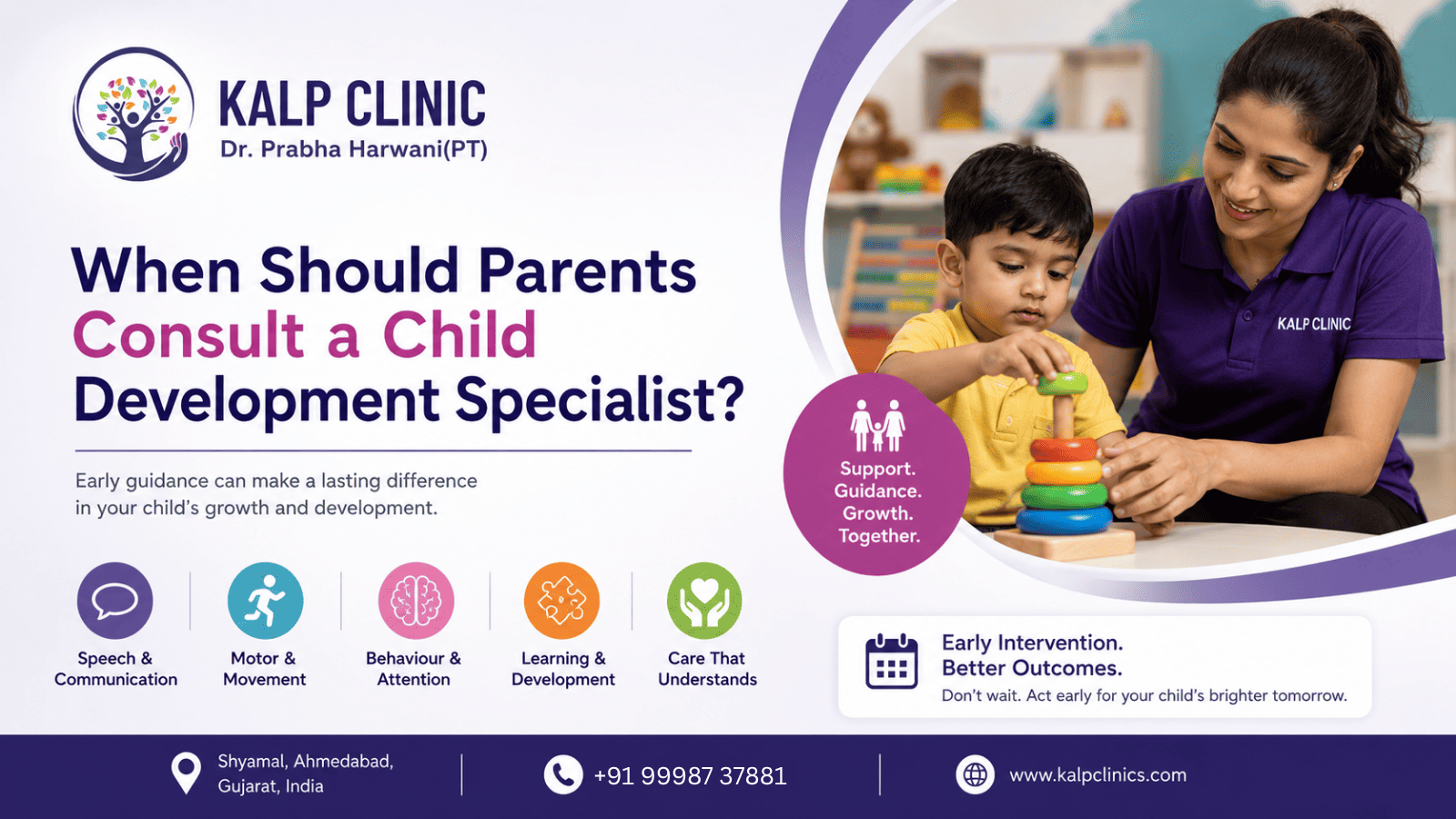
Every parent wants to see their child grow, learn, communicate, play, and become independent. But children do not all develop in exactly the same way. One child may start speaking early, while another may develop physical skills first. Some children need more time to become comfortable socially, while others may require additional support with attention, learning, behaviour, or coordination.
This is why many parents eventually ask an important question: When should I consult a child development specialist?
The answer is not always about waiting for a major problem. Sometimes, a small but persistent concern is enough to seek professional guidance. A developmental consultation can help parents understand their child's current abilities, identify areas that may need support, and decide whether monitoring, therapy, or further assessment is appropriate.
At Kalp Clinic in Shyamal, Ahmedabad, Dr. Prabha Harwani (PT) – Paediatric Therapist, and the therapy team support children with developmental, communication, behavioural, learning, neurological, and physical challenges through individualized therapy programs.
What Is a Child Development Specialist?
A child development specialist focuses on how children develop important skills across different areas of life.
Child development is broader than speech or physical growth. It can include:
-
Communication and language
-
Gross and fine motor development
-
Attention and concentration
-
Learning and school readiness
-
Social interaction
-
Emotional regulation
-
Behaviour
-
Sensory processing
-
Play skills
-
Daily living and self-care
-
Physical coordination and mobility
-
Functional independence
Modern child development support increasingly emphasizes the whole child, rather than looking at one isolated symptom. This can help parents understand both the child's challenges and strengths.
10 Signs That May Mean Your Child Needs Professional Guidance
There is no single checklist that applies equally to every child. However, certain patterns deserve attention when they persist or interfere with everyday life.
1. Your Child Seems to Be Falling Behind in Several Areas
Parents may notice that their child is struggling with multiple developmental skills compared with what is generally expected for their age.
For example, a child may have difficulty with:
-
Communication
-
Movement
-
Playing with others
-
Following simple instructions
-
Learning new activities
-
Managing everyday routines
-
Becoming independent
One difference does not automatically indicate a developmental disorder. However, several ongoing concerns together are a good reason to discuss the child's development with a qualified professional.
2. Your Child Is Struggling With Everyday Communication
Communication is not limited to speaking words. Children communicate through sounds, gestures, facial expressions, understanding, and interaction.
Parents may consider an assessment if a child consistently has difficulty:
-
Expressing basic needs
-
Understanding age-appropriate instructions
-
Using words or sentences
-
Answering simple questions
-
Participating in conversations
-
Communicating with family members
-
Using gestures meaningfully
-
Making themselves understood
If communication difficulties are affecting home or school participation, professional evaluation can help determine what type of support may be appropriate.
For families searching for a Best Child Speech Therapist in Ahmedabad or Speech Delay Treatment for Kids, the first step should be understanding the child's individual communication profile rather than relying only on age comparisons.
3. Your Child Has Difficulty With Movement, Balance, or Coordination
Physical development affects how children explore their environment and participate in play and daily activities.
Concerns may include:
-
Frequent difficulty maintaining balance
-
Problems climbing stairs
-
Difficulty running or jumping
-
Poor coordination
-
Unusual walking patterns
-
Difficulty using both hands together
-
Difficulty participating in physical activities
-
Delayed development of age-appropriate motor skills
A Paediatric Physiotherapy Center can assess movement, strength, posture, balance, coordination, and functional abilities.
For children with neurological or developmental conditions, Paediatric Neurological Physiotherapy may be part of a broader rehabilitation plan.
4. Your Child Has Difficulty Paying Attention or Managing Activity Levels
Being energetic is a normal part of childhood. However, persistent difficulties with attention, impulse control, or participation can interfere with learning and everyday routines.
Parents may notice:
-
Difficulty completing simple activities
-
Frequent distraction
-
Trouble following instructions
-
Constant movement
-
Impulsive responses
-
Difficulty waiting for a turn
-
Difficulty staying engaged in classroom activities
-
Frequent interruptions
-
Problems transitioning between activities
Instead of assuming that every active child has ADHD, parents should seek a proper assessment when these difficulties consistently affect functioning.
Kalp Clinic provides ADHD Therapy and paediatric therapy approaches designed around attention, behaviour regulation, participation, and everyday functioning. (Kalp Clinic)
5. Your Child Finds Social Interaction Difficult
Social development is an important part of childhood.
Some children may find it difficult to:
-
Join other children in play
-
Respond appropriately during interaction
-
Share attention with others
-
Understand social cues
-
Take turns
-
Maintain age-appropriate interaction
-
Participate in group activities
-
Build relationships with peers
These signs do not automatically mean autism. There can be many reasons for social difficulties.
However, persistent differences in communication, interaction, play, or repetitive behaviours may justify discussing concerns with a paediatrician or developmental professional.
For children who require specialized support, an Autism Treatment Centre can provide structured intervention addressing communication, social participation, behaviour, sensory needs, and daily living skills. Kalp Clinic currently offers autism therapy among its paediatric services. (Kalp Clinic)
6. Behaviour Is Interfering With Family or School Life
Behaviour is often a child's way of communicating a need, frustration, difficulty, or emotional response.
Parents may need professional guidance when challenging behaviours are frequent or significantly interfere with everyday activities.
Examples include:
-
Frequent intense tantrums
-
Aggression
-
Difficulty following routines
-
Refusal to participate in activities
-
Extreme frustration
-
Difficulty handling transitions
-
Repeated disruptive behaviour
-
Difficulty regulating emotions
-
Problems following classroom expectations
The goal of professional behaviour support should not simply be to make a child "obedient." Effective intervention should consider the child's communication, environment, developmental abilities, emotional regulation, and underlying needs.
Behaviour Modification Therapy may be recommended when behavioural challenges require structured intervention.
7. Your Child Has Difficulty With Learning or School Readiness
Learning difficulties can sometimes become noticeable when children enter preschool or school.
Parents and teachers may observe problems with:
-
Recognizing letters or numbers
-
Remembering instructions
-
Early reading skills
-
Writing and handwriting
-
Completing age-appropriate tasks
-
Understanding concepts
-
Maintaining attention
-
Organizing schoolwork
-
Participating in classroom activities
These difficulties do not necessarily mean that a child has low intelligence. Children can have different learning profiles and may need different teaching strategies.
A Paediatric Special Education Center for Kids can support children who require individualized educational approaches.
Similarly, Top Remedial Education for Kids focuses on strengthening specific academic skills through structured practice and individualized learning strategies.
8. Your Child Has Feeding or Oro-Motor Difficulties
Parents sometimes overlook feeding difficulties when considering child development.
A child may require professional attention when they consistently experience problems such as:
-
Difficulty chewing
-
Difficulty managing certain textures
-
Strong food avoidance
-
Difficulty using the tongue or lips effectively
-
Problems with oral coordination
-
Difficulty progressing with age-appropriate eating skills
An Oro Motor Therapy Center can provide targeted support when oral-motor development is contributing to feeding or communication difficulties.
The right approach depends on the child's assessment and individual needs.
9. Your Child Is Having Difficulty Becoming Independent
Development is also measured by how children gradually learn to participate in everyday activities.
Parents may notice that their child needs significantly more help than expected with:
-
Dressing
-
Eating
-
Brushing teeth
-
Using a pencil
-
Managing school materials
-
Following routines
-
Toileting
-
Cleaning up after activities
-
Participating in age-appropriate household tasks
Therapy can focus on functional skills that help children participate more independently at home, school, and in the community.
This functional development approach is becoming increasingly important because the goal of therapy is not only to improve a particular skill during a session but also to help children use that skill in real-life situations.
10. Your Child Has Lost a Skill They Previously Had
Developmental regression deserves particular attention.
For example, if a child previously used certain words, interacted in a particular way, or performed a skill independently and then loses that ability, parents should discuss the change with their paediatrician or appropriate healthcare professional.
Parents should document when the change started and describe exactly what skill was lost.
Do not assume that developmental regression is simply a temporary phase.
Why Early Developmental Guidance Matters
One of the biggest changes in modern child development care is the growing focus on early intervention.
Parents sometimes wait because they think:
"Maybe my child will catch up."
Sometimes children do develop a skill later without intervention. But when concerns persist, waiting without professional guidance can leave parents uncertain about what they should do next.
Early assessment can provide:
-
Better understanding of the child's strengths
-
Identification of areas requiring support
-
Individualized therapy recommendations
-
Practical home strategies
-
Better coordination between parents and therapists
-
Support for school participation
-
Regular progress monitoring
The objective is not to label a child unnecessarily. It is to understand the child's needs and provide appropriate support.
Developmental Screening vs. Diagnosis: What Parents Should Know
Parents often confuse developmental screening with diagnosis.
A developmental screening is designed to identify children who may need further evaluation. It does not necessarily provide a final diagnosis.
A detailed assessment may then be recommended depending on the concerns identified.
This distinction is important because one behaviour or one delayed skill should not be used to self-diagnose a child.
For example:
Speech delay does not automatically mean autism.
High activity does not automatically mean ADHD.
Difficulty learning one subject does not automatically mean a learning disorder.
Late walking does not automatically indicate a neurological condition.
Professional assessment looks at the complete developmental picture.
What Should Parents Expect During a Consultation?
A first consultation is an opportunity to discuss concerns and understand the child's current abilities.
Depending on the child's needs, the process may include:
-
Parent discussion
-
Developmental history
-
Observation of the child's behaviour
-
Communication assessment
-
Motor skill observation
-
Play-based activities
-
Attention and participation assessment
-
Functional skill evaluation
-
Review of school concerns
-
Discussion of previous reports
-
Recommendations for therapy or further assessment
At Kalp Clinic, therapy programs are designed according to each child's individual developmental profile rather than applying exactly the same program to every child. (Kalp Clinic)
Questions Parents Should Ask a Child Development Specialist
Parents can make the consultation more productive by asking clear questions.
Consider asking:
-
Which developmental areas should we focus on?
-
Is my child's current development within an expected range?
-
Which skills should we monitor?
-
Does my child need therapy?
-
Which therapy would be most appropriate?
-
How frequently should progress be reviewed?
-
What activities can we practice at home?
-
What should we discuss with the child's school?
-
When should we return for reassessment?
Taking notes before the appointment can also help parents explain their concerns clearly.
Choosing the Right Child Development Center
When searching online for the Best Child Development Center in Shyamal Ahmedabad or the Best Paediatric Therapy Center Ahmedabad, parents should look beyond advertisements and rankings.
Consider factors such as:
-
Qualified and experienced therapists
-
Individualized therapy planning
-
Child-friendly environment
-
Multidisciplinary services
-
Parent involvement
-
Regular progress monitoring
-
Clear communication with families
-
Appropriate referral when additional medical evaluation is required
-
Therapy goals connected to real-life activities
A good therapy center should make parents feel informed and involved in their child's developmental journey.
Kalp Clinic – Child Development & Paediatric Therapy in Shyamal, Ahmedabad
Kalp Clinic is a Child Development and Paediatric Therapy Center in Shyamal, Ahmedabad, led by Dr. Prabha Harwani (PT) – Paediatric Therapist.
The clinic provides individualized support for children experiencing developmental, behavioural, communication, learning, neurological, and physical challenges. Its current services include paediatric physiotherapy, neuro physiotherapy, occupational therapy, oro-motor therapy, speech therapy, behaviour modification therapy, remedial education, autism treatment, ADHD therapy, and child rehabilitation. (Kalp Clinic)
Kalp Clinic's approach focuses on understanding the child's individual needs and developing appropriate therapy goals with family involvement.
Parents looking for a Best Child Paediatric Rehabilitation Center in Ahmedabad can discuss their child's developmental concerns with the professional team and understand which services may be appropriate for their child's needs.
When Is the Right Time to Seek Help?
Parents do not have to wait until a difficulty becomes severe.
Consider arranging a professional consultation when:
-
You have a persistent concern about development
-
Your child is struggling in more than one developmental area
-
Communication difficulties affect everyday life
-
Movement or coordination problems limit activities
-
Behaviour is affecting family or school routines
-
Learning difficulties are becoming noticeable
-
Social interaction is consistently challenging
-
Feeding or oral-motor difficulties persist
-
Your child is struggling with independence
-
A previously acquired skill has been lost
-
A teacher or caregiver has raised repeated concerns
Most importantly, trust your observations while avoiding unnecessary comparisons with other children.
Every child has a unique developmental journey. Some differences are simply part of individual development, while others may benefit from timely professional support.
The most important step is to notice, understand, and act when concerns persist.
A child development consultation is not about placing a label on a child. It is about understanding where the child is today, identifying strengths and challenges, and determining what support could help the child participate more confidently at home, school, and in everyday life.
If you are concerned about your child's speech, movement, behaviour, attention, learning, social interaction, feeding, or independence, consider discussing those concerns with an appropriate paediatric or child development professional.
At Kalp Clinic, Shyamal, Ahmedabad, Dr. Prabha Harwani (PT) – Paediatric Therapist and the therapy team provide personalized paediatric therapy and developmental support for children and families.
Website: www.kalpclinics.com
Location: Shyamal, Ahmedabad, Gujarat, India
Kalp Clinic – Supporting children with professional guidance, individualized therapy, and family-centered care.