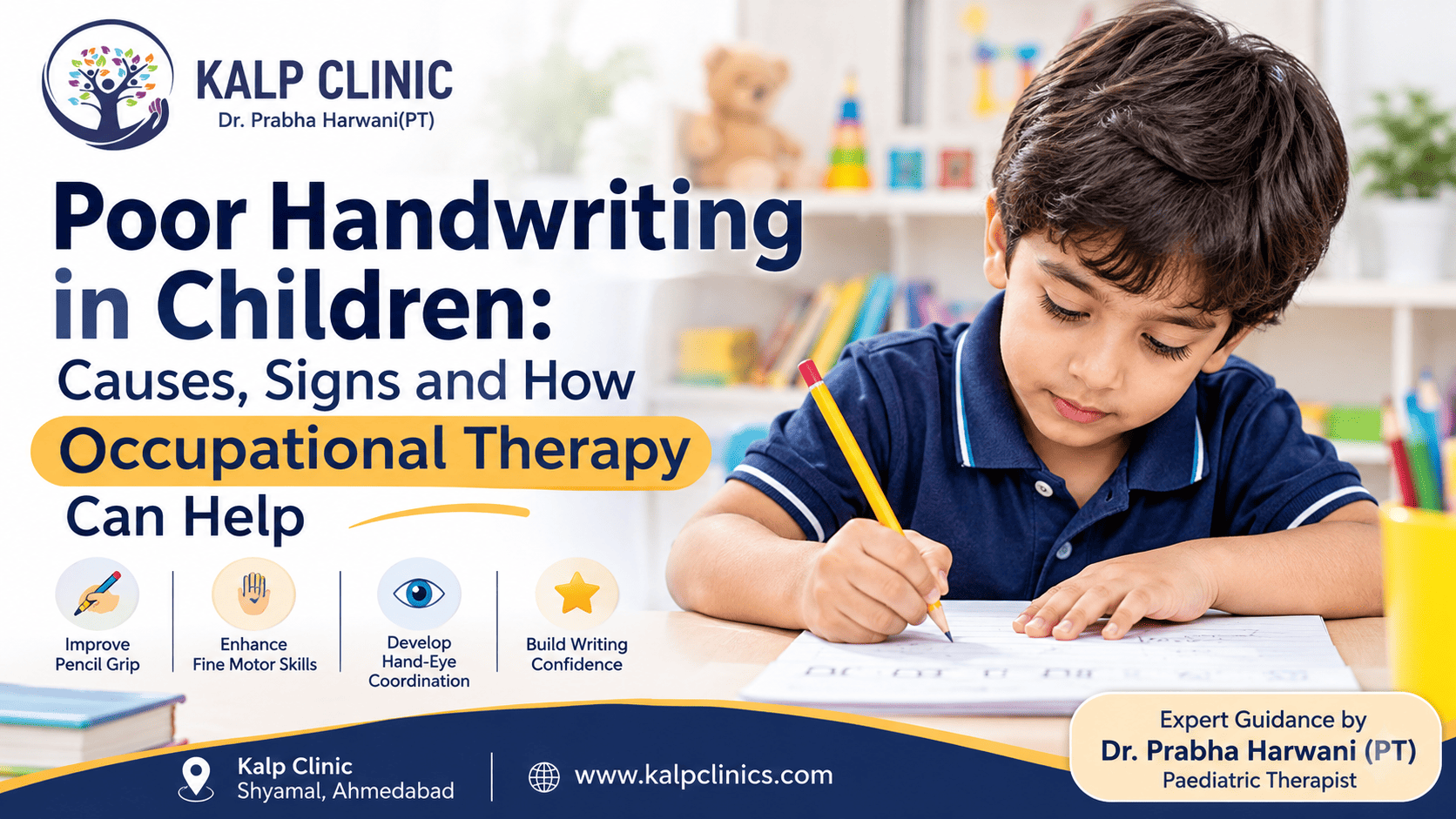
Handwriting is an important skill that children use throughout their school years. From writing their names and completing classroom assignments to drawing pictures and expressing their thoughts, children depend on handwriting for everyday learning activities.
However, some children struggle to develop clear, consistent, and comfortable handwriting. They may hold a pencil awkwardly, press too hard on the paper, write very slowly, struggle to maintain letter size, or become frustrated when asked to complete written work.
These difficulties are not always related to a lack of interest or practice. In some cases, children experience challenges with hand coordination, finger movements, visual-motor integration, posture, or the ability to organise movements while writing.
For parents, recognising these difficulties early can make it easier to understand what kind of support may be helpful.
Occupational Therapy for Handwriting Problems focuses on identifying the underlying skills involved in writing and supporting children as they develop more effective ways to manage everyday writing activities.
At Kalp Clinic, located in Shyamal, Ahmedabad, Dr. Prabha Harwani (PT) – Paediatric Therapist, provides paediatric therapy guidance to parents concerned about their children's developmental and functional skills.
This article explains common handwriting difficulties in children, possible contributing factors, signs parents should observe, and how occupational therapy may support handwriting development.
1. Why Is Handwriting Development Important for Children?
Handwriting is more than the ability to form letters correctly. It involves several physical, visual, cognitive, and coordination skills working together.
When children write, they need to:
-
Hold and control a pencil.
-
Move their fingers with accuracy.
-
Coordinate their hands and eyes.
-
Maintain an appropriate sitting position.
-
Recognise letters and understand their shapes.
-
Control writing speed and pressure.
-
Organise letters and words on a page.
-
Maintain attention during written activities.
These abilities develop gradually through childhood experiences and practice.
Children who experience difficulties in one or more of these areas may find classroom writing more demanding than their classmates.
For example, a child may understand a lesson perfectly but struggle to complete written answers within the available time. Another child may enjoy drawing but find it difficult to form letters consistently.
Understanding these differences is important because handwriting challenges should not automatically be interpreted as laziness, carelessness, or a lack of intelligence.
2. Common Signs of Handwriting Difficulties in Children
Parents and teachers are often the first people to notice when a child struggles with writing activities.
Some children show difficulties from the beginning of formal schooling, while others experience problems as classroom writing requirements become more demanding.
Watch for these common signs:
1. Poor Pencil Grip
The child may hold the pencil too tightly, use an uncomfortable grip, or struggle to control pencil movements.
2. Inconsistent Letter Formation
Letters may appear different each time the child writes them, with unusual shapes or incorrect starting points.
3. Uneven Letter Size
Some letters may be unusually large while others are very small, making written work difficult to read.
4. Difficulty Maintaining Spacing
The child may leave irregular spaces between letters and words or struggle to keep writing within designated lines.
5. Slow Writing Speed
The child may take significantly longer than expected to complete classroom assignments or written homework.
6. Excessive Pencil Pressure
Some children press very hard while writing, while others apply too little pressure to produce clear marks.
7. Poor Handwriting Endurance
The child may complain of hand tiredness, discomfort, or difficulty continuing longer writing tasks.
8. Avoiding Written Activities
Children who repeatedly struggle with handwriting may become frustrated, lose confidence, or avoid drawing and writing activities.
These signs do not automatically indicate a disorder. However, when difficulties consistently affect classroom participation or everyday activities, professional guidance may be helpful.
3. What Causes Poor Handwriting in Children?
There is no single explanation for every handwriting difficulty. Writing involves several connected abilities, and a child may experience challenges in one or multiple areas.
Understanding possible contributing factors helps parents identify what should be discussed during an assessment.
A. Underdeveloped Fine Motor Skills
Fine motor skills involve the controlled movement of small muscles, particularly in the hands and fingers.
Children use these skills for activities such as:
-
Holding crayons and pencils.
-
Picking up small objects.
-
Turning pages.
-
Using scissors.
-
Buttoning clothes.
-
Manipulating building blocks.
When fine motor control is still developing, children may find it difficult to manage pencil movements with accuracy.
B. Poor Hand-Eye Coordination
Hand-eye coordination allows children to use visual information to guide hand movements.
It is important for copying letters, drawing shapes, following writing lines, and maintaining consistent spacing.
Some children may understand what they want to write but struggle to coordinate their hand movements with what they see.
C. Difficulty With Visual-Motor Integration
Visual-motor integration involves coordinating visual information with physical movements.
For handwriting, children need to recognise a letter's shape and reproduce it using controlled hand movements.
Difficulties in this area may affect letter formation, copying from the board, drawing within boundaries, and organising written work.
D. Posture and Sitting Stability
Writing requires children to maintain a reasonably stable sitting position while moving their hands.
Poor seating arrangements, inadequate desk height, or difficulties maintaining postural stability may make writing activities more challenging.
E. Hand Strength and Dexterity
Some children may have difficulty controlling small finger movements or maintaining the hand position needed for writing.
This can affect pencil manipulation, movement accuracy, and the ability to complete longer writing tasks comfortably.
F. Attention and Motor Planning
Writing involves planning and organising a sequence of movements.
Children who struggle with attention or motor planning may find it difficult to begin writing, maintain consistency, or complete multi-step written tasks.
These factors should be considered individually rather than assuming that every child with poor handwriting has the same underlying difficulty.
4. How Occupational Therapy Helps Children With Handwriting Problems
Occupational therapy can help children develop the functional skills needed to participate more comfortably in writing and other school-related activities.
The first step is understanding why the child is struggling. Rather than focusing only on making handwriting look neat, an occupational therapy approach considers the child's actual writing performance and the skills needed to improve it.
The Occupational Therapy for Handwriting Problems approach may include the following areas, depending on the child's assessment.
A. Pencil Grip and Pencil Control
A comfortable and functional pencil grasp helps children control their writing movements.
Therapy activities may focus on:
-
Improving finger positioning and pencil manipulation.
-
Developing controlled finger movements.
-
Practising different drawing and tracing patterns.
-
Learning to adjust pencil pressure.
-
Using age-appropriate writing tools.
It is important to remember that there is no single pencil grip that every child must use. The focus should be on functional, comfortable, and effective control.
B. Fine Motor Skills Development
Fine motor activities help children practise controlled movements of their fingers and hands.
Depending on individual needs, activities may include:
-
Picking up and sorting small objects.
-
Playing with age-appropriate construction toys.
-
Using child-safe tweezers.
-
Threading beads.
-
Playing with modelling dough.
-
Opening and closing containers.
-
Practising finger isolation movements.
These activities can complement direct handwriting practice.
C. Visual-Motor Integration
Children need to coordinate what they see with how they move their hands.
Therapy may include activities such as:
-
Copying simple shapes and patterns.
-
Connecting dots.
-
Drawing within boundaries.
-
Completing age-appropriate mazes.
-
Copying letters and numbers.
-
Practising alignment on ruled paper.
The activities should match the child's current abilities and gradually become more challenging.
D. Handwriting Practice and Letter Formation
Direct practice of handwriting is an important part of improving writing skills.
Children may practise:
-
Starting letters at the correct points.
-
Following consistent letter-formation patterns.
-
Maintaining appropriate letter size.
-
Developing spacing between words.
-
Writing on designated lines.
-
Improving writing accuracy and consistency.
According to the American Occupational Therapy Association (AOTA), therapeutic handwriting practice has strong evidence for supporting handwriting development. Isolated exercises that work only on underlying skills without actual handwriting practice are not an adequate substitute.
E. Posture and Writing Position
A suitable working position can make writing activities more manageable.
Children may receive guidance about:
-
Sitting with appropriate back support.
-
Keeping feet supported where possible.
-
Positioning the writing surface comfortably.
-
Maintaining a stable paper position.
-
Using the assisting hand to hold the paper.
The aim is to make writing comfortable and functional rather than forcing every child into an identical posture.
5. Handwriting Improvement Activities for Kids at Home
Parents can provide additional opportunities to practise writing-related skills through everyday activities.
Here are some practical Handwriting Improvement Activities for Kids that can be introduced at home.
1. Playdough Activities
Encourage children to roll, squeeze, flatten, and shape playdough. These activities provide opportunities to use their hands and fingers in different ways.
2. Drawing and Colouring
Let children draw simple pictures, colour shapes, and experiment with different drawing tools.
3. Bead Threading
Age-appropriate bead threading encourages controlled hand movements and coordination. Use large beads and supervise young children.
4. Tracing Simple Shapes
Encourage children to trace circles, lines, curves, and simple patterns before progressing to more complex designs.
5. Paper Cutting Activities
Supervised cutting with age-appropriate scissors helps children practise coordinated hand movements.
Parents should keep activities short, enjoyable, and appropriate for their child's age. These home activities are supportive opportunities, not a replacement for individual assessment or structured handwriting intervention when difficulties persist.
6. When Should Parents Consult a Paediatric Therapist?
Occasional messy handwriting is common while children are learning. However, persistent difficulties deserve attention when they interfere with schoolwork or everyday activities.
Consider professional guidance if your child:
-
Consistently struggles to hold and control a pencil.
-
Finds copying letters and numbers unusually difficult.
-
Cannot maintain appropriate spacing between words.
-
Takes considerably longer to complete writing assignments.
-
Experiences frequent hand tiredness during writing.
-
Avoids drawing, colouring, or written homework.
-
Has difficulty copying information from the classroom board.
-
Shows frustration or reduced confidence during writing activities.
An assessment can help identify the child's strengths, specific challenges, and appropriate support options.
7. How to Choose the Right Paediatric Occupational Therapy Centre in Ahmedabad
Choosing a suitable therapy centre is an important decision for parents. If you are searching for Best Paediatric Occupational therapy for children in Shyamal Ahmedabad, consider more than convenience or proximity.
Look for the following:
1. Child-Focused Assessment: The professional should understand the child's writing difficulties, daily activities, and developmental history.
2. Individualised Therapy Goals: Recommendations should reflect the child's age, abilities, and specific writing challenges.
3. Functional Handwriting Practice: Activities should connect directly with real writing tasks rather than focusing only on general hand exercises.
4. Parent Guidance: Parents should understand how to support writing activities at home without creating unnecessary pressure.
5. Progress Monitoring: Changes in letter formation, legibility, writing comfort, and task completion should be reviewed.
6. School Collaboration: When appropriate, communication with teachers can help make classroom writing activities more manageable.
Parents searching for a Top Child Handwriting Development Center Shyamal Ahmedabad should also verify the centre's available services, professional qualifications, and experience with children's functional writing difficulties.
8. How Kalp Clinic Supports Children's Development
Children develop handwriting and other functional skills at different rates. When writing difficulties begin affecting school participation, understanding the child's individual needs becomes important.
Kalp Clinic, located in Shyamal, Ahmedabad, Gujarat, provides paediatric therapy guidance for parents seeking support with childhood developmental and functional challenges.
Under the guidance of Dr. Prabha Harwani (PT) – Paediatric Therapist, parents can discuss concerns about their child's developmental abilities and explore appropriate assessment and therapeutic recommendations.
For families concerned about handwriting development, relevant discussion areas include:
-
Pencil control and functional grasp.
-
Fine motor coordination.
-
Hand-eye coordination.
-
Visual-motor skills.
-
Writing-related difficulties at school.
-
Participation in age-appropriate activities.
-
Parent-guided activities for everyday practice.
Where occupational therapy is indicated, parents can discuss the appropriate service and professional support available through the clinic.
Kalp Clinic aims to help parents understand their children's individual developmental needs and make informed decisions about suitable therapeutic guidance.
If you are looking for Occupational Therapy for Children in Ahmedabad, contact Kalp Clinic to discuss your child's handwriting concerns and available consultation options.
Kalp Clinic – Contact Information
-
Company Name: Kalp Clinic
-
Paediatric Therapist: Dr. Prabha Harwani (PT)
-
Location: Shyamal, Ahmedabad, Gujarat, India
-
Website: www.kalpclinics.com
Conclusion
Poor handwriting in children is not always a matter of insufficient practice. Difficulties with pencil control, fine motor coordination, visual-motor integration, posture, and writing movements can all affect how comfortably a child completes written activities.
Identifying these challenges can help parents understand why their child struggles and what kind of support may be appropriate.
Occupational Therapy for Handwriting Problems focuses on improving functional writing abilities through individual assessment, meaningful handwriting practice, and activities suited to the child's needs.
If your child experiences persistent handwriting difficulties, consider discussing your concerns with Dr. Prabha Harwani (PT), Paediatric Therapist at Kalp Clinic, Shyamal, Ahmedabad.
With appropriate guidance, regular practice, and cooperation between parents, professionals, and teachers, children can work towards more comfortable and effective participation in school writing activities.
Visit www.kalpclinics.com to learn more about Kalp Clinic.
Frequently Asked Questions (FAQs)
1. Can occupational therapy improve handwriting in children?
Occupational therapy can help children who experience difficulties with handwriting by addressing functional writing skills, pencil control, letter formation, and writing practice. The intervention depends on the child's individual assessment.
2. What causes poor pencil grip in children?
Poor pencil grip may be associated with developing hand control, finger coordination, dexterity, or comfort during writing. An unusual grip does not automatically indicate a problem if the child can write comfortably and effectively.
3. At what age should a child start handwriting practice?
Children develop pre-writing and writing abilities gradually. Early experiences may include scribbling, drawing, tracing, and making simple shapes. Formal handwriting expectations should be appropriate to the child's age, educational stage, and individual development.
4. How can parents improve handwriting at home?
Parents can encourage drawing, colouring, tracing, playdough activities, bead threading, and short, enjoyable handwriting sessions. If difficulties persist, professional assessment can help identify more suitable activities.
5. Does poor handwriting mean a child has dysgraphia?
No. Poor handwriting alone does not establish dysgraphia. Handwriting difficulties can have different causes, and appropriate assessment is needed to understand whether a specific learning or motor-related difficulty is present.
6. Can fine motor skill difficulties affect school performance?
Yes. Fine motor difficulties may make writing, drawing, using classroom tools, and completing certain school activities more challenging. The effect varies from child to child.
7. How long does occupational therapy take to improve handwriting?
There is no fixed duration. Progress depends on the child's needs, starting abilities, therapy goals, practice opportunities, and consistency. The therapist should review progress and adjust goals accordingly.
8. Which is the best paediatric occupational therapy centre in Shyamal, Ahmedabad?
Parents should evaluate professional qualifications, paediatric experience, individual assessment, handwriting intervention methods, and parent involvement. Kalp Clinic in Shyamal, Ahmedabad, provides paediatric therapy guidance under Dr. Prabha Harwani (PT).
9. Should a child continue handwriting practice if their hand gets tired?
Children should not be forced to continue through pain or significant discomfort. Parents should discuss frequent fatigue, discomfort, or avoidance of writing with a qualified professional to understand possible contributing factors.
10. Can handwriting difficulties affect older school-going children?
Yes. Some children continue experiencing difficulties with writing speed, legibility, written assignments, and classroom participation as academic demands increase. Support should address their current school requirements and functional needs.