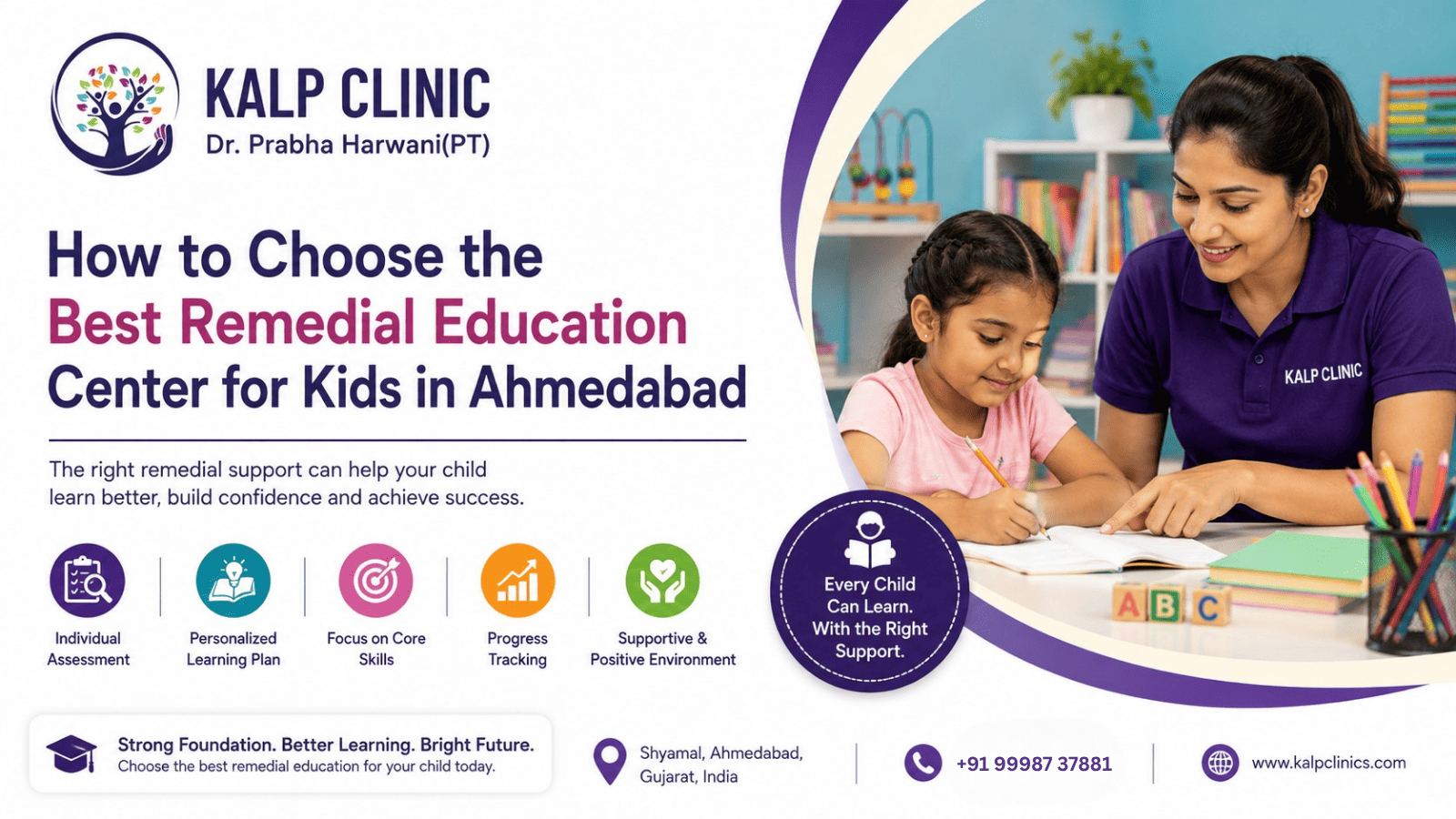
Every child learns differently. While some children quickly understand reading, writing, mathematics, and classroom instructions, others may need additional time, different teaching methods, or individualized educational support. When a child consistently struggles with schoolwork despite regular teaching and practice, parents may start looking for remedial education for kids.
Choosing the right center is an important decision. Remedial education should not simply mean giving a child more homework or additional tuition. A good program should identify the child's specific learning needs, build on their strengths, and use structured strategies to improve academic and functional skills.
The American Academy of Pediatrics notes that learning differences can affect skills such as reading, writing, mathematics, attention, and processing information, and children can benefit from support that targets their individual strengths and areas of difficulty.
For parents searching for the Best Remedial Education Center for Kids in Ahmedabad, this guide explains what to look for and how to make a more informed choice.
What Is Remedial Education for Kids?
Remedial education is specialized educational support designed for children who experience difficulties with particular learning skills.
The purpose is not to repeat the same classroom teaching. Instead, a remedial educator identifies areas where the child is struggling and uses suitable teaching strategies, structured activities, and repeated practice to strengthen those skills.
Depending on the child's needs, remedial education may focus on:
- Reading and phonics
- Spelling and vocabulary
- Writing and handwriting
- Reading comprehension
- Mathematics and number concepts
- Attention and task completion
- Memory and information processing
- Following instructions
- Organization and study habits
- School readiness
- Academic confidence
- Functional learning skills
Remedial education can therefore be useful for children with specific academic difficulties as well as children who need additional individualized learning support.
Why Do Some Children Need Remedial Education?
A child may struggle academically for many different reasons. Poor grades alone do not tell parents why a child is having difficulty.
Possible contributing factors can include:
- Specific learning difficulties
- Reading or spelling challenges
- Writing difficulties
- Difficulty understanding mathematical concepts
- Attention and concentration problems
- Language or communication difficulties
- Developmental differences
- Memory and processing challenges
- Difficulty following multi-step instructions
- Poor handwriting or fine-motor skills
- Lack of confidence after repeated academic struggles
The American Academy of Pediatrics recommends looking beyond academic performance and considering the broader developmental, behavioural, learning, and environmental factors that may contribute to school difficulties.
This is why a quality remedial education center in Ahmedabad should focus on understanding the child rather than simply trying to increase marks.
Signs Your Child May Benefit From Remedial Education
Parents may consider professional educational support when difficulties become persistent rather than occasional.
Some common signs include:
- Reading significantly below the expected level
- Difficulty recognizing or remembering words
- Frequent spelling mistakes
- Difficulty understanding what has been read
- Poor handwriting or difficulty writing clearly
- Difficulty copying from the board
- Trouble remembering basic mathematical concepts
- Difficulty solving age-appropriate word problems
- Taking unusually long to complete homework
- Forgetting instructions shortly after receiving them
- Avoiding reading or writing activities
- Becoming frustrated during homework
- Losing confidence in schoolwork
- Requiring repeated explanations of the same concept
These signs do not automatically mean that a child has a learning disability. A proper assessment may be needed to understand the underlying difficulties.
Remedial Education Is Not the Same as Regular Tuition
One of the most important things parents should understand is the difference between remedial education and regular tuition.
Traditional tuition generally follows the school curriculum and gives students additional practice.
Remedial education is more individualized.
A remedial program may:
- Identify specific learning gaps
- Break complex concepts into smaller steps
- Adapt teaching methods to the child's learning style
- Use multisensory learning activities
- Provide additional repetition and practice
- Track specific skills over time
- Adjust activities according to progress
- Focus on foundational skills before advanced concepts
For example, if a child struggles with reading, simply asking the child to read more pages may not solve the problem. A structured program may first examine phonological awareness, letter-sound relationships, decoding, fluency, vocabulary, and comprehension.
7 Things Parents Should Check Before Choosing a Remedial Education Center
1. Look for Individualized Learning Plans
Every child has a different learning profile.
A good center should avoid using exactly the same program for every child. Instead, the educator should identify the child's current abilities and create appropriate learning goals.
Ask:
- What are my child's main learning difficulties?
- Which skills will be targeted first?
- How will progress be measured?
- Will the program change as my child improves?
Individualized educational assessment and programming are also recognized within specialized education services in Ahmedabad.
2. Understand the Assessment Process
Before starting regular remedial sessions, parents should understand how the center identifies learning needs.
Assessment may consider:
- Reading ability
- Writing skills
- Spelling
- Mathematical understanding
- Attention
- Memory
- Language
- Fine-motor abilities
- School performance
- Functional learning skills
A comprehensive learning evaluation can involve academic achievement testing as well as consideration of language, memory, attention, motor, emotional, and social factors when appropriate.
If the child's difficulties suggest a condition requiring specialist evaluation, the center should also be willing to recommend an appropriate referral.
3. Check the Qualifications and Experience of the Team
Parents should understand who will actually work with their child.
Ask about:
- Professional qualifications
- Experience working with children
- Experience with learning difficulties
- Special education experience
- Understanding of child development
- Collaboration with therapists or other professionals
A multidisciplinary environment can be especially useful when academic difficulties overlap with communication, behaviour, attention, sensory, motor, or developmental concerns.
4. Look for a Child-Friendly Learning Environment
Children who already struggle academically may feel anxious about additional classes.
A good environment should make learning feel safe and achievable.
Look for:
- Comfortable learning spaces
- Age-appropriate activities
- Positive communication
- Encouragement rather than criticism
- Individual attention
- Opportunities for success
- Activities that maintain engagement
The aim should be to help children become more confident learners rather than making them feel that they are constantly being tested.
5. Ask How Progress Is Monitored
A remedial education program should have measurable goals.
Parents can ask:
- What skills are being measured?
- How frequently is progress reviewed?
- How are goals updated?
- Will parents receive progress feedback?
- What happens if the child is not responding as expected?
Progress monitoring allows the educational plan to evolve according to the child's development.
6. Consider Parent Involvement
Parents play an important role in reinforcing learning outside the center.
However, parent involvement does not mean turning the home into another classroom.
A good center can provide practical suggestions such as:
- Short reading activities
- Everyday mathematics games
- Writing practice
- Vocabulary activities
- Memory exercises
- Organizational routines
- Homework strategies
- Positive reinforcement techniques
Parents should understand what to practice, how often to practice, and when to stop an activity if the child becomes overwhelmed.
7. Look Beyond Promises About Marks
Parents should be cautious about centers that guarantee dramatic academic results within a fixed period.
Learning is individual.
A quality program should focus on meaningful progress such as:
- Better reading fluency
- Improved comprehension
- More accurate writing
- Stronger mathematical understanding
- Better task participation
- Greater independence
- Improved confidence
- More effective learning strategies
The American Academy of Pediatrics emphasizes interventions that support healthy development rather than focusing only on changing grades.
Which Learning Areas Can Remedial Education Support?
A well-designed remedial education program for children can address several academic foundations.
Reading Skills
Support may include:
- Letter-sound recognition
- Phonics
- Word decoding
- Reading fluency
- Vocabulary
- Reading comprehension
- Sequencing and recall
Writing Skills
Children may receive support with:
- Letter formation
- Handwriting
- Spacing
- Spelling
- Sentence formation
- Written expression
- Organizing ideas
Mathematics
Remedial support can target:
- Number recognition
- Counting
- Number relationships
- Basic calculations
- Mathematical vocabulary
- Problem-solving
- Understanding word problems
Attention and Learning Organization
Some children need help with:
- Starting tasks
- Following instructions
- Staying engaged
- Completing assignments
- Organizing materials
- Remembering steps
- Managing study routines
The specific approach should always depend on the child's assessment and individual needs.
What About Dyslexia, Dysgraphia, and Dyscalculia?
Parents may encounter terms such as dyslexia, dysgraphia, and dyscalculia while researching learning difficulties.
In simple terms:
- Dyslexia is associated primarily with difficulties involving reading and language processing.
- Dysgraphia may involve significant difficulties with written expression or writing-related skills.
- Dyscalculia involves difficulties with mathematical learning and number-related concepts.
These terms should not be used as self-diagnoses based on a few school difficulties.
For example, difficulty reading does not automatically mean dyslexia. A proper evaluation considers the child's history, academic performance, and specific pattern of strengths and difficulties.
When a learning disorder is suspected, parents may need a broader educational or developmental evaluation in addition to remedial education.
When Should Parents Seek Professional Assessment?
Parents should consider professional guidance when academic difficulties are persistent and begin affecting everyday school life.
It may be appropriate to seek help when:
- School struggles continue despite regular practice
- Teachers repeatedly report concerns
- The child avoids academic activities
- Homework causes frequent frustration
- Reading or writing difficulties are becoming more noticeable
- Mathematical concepts remain difficult despite repeated teaching
- The child has difficulty following instructions
- Attention problems affect classroom participation
- Learning difficulties are accompanied by speech, behavioural, developmental, or motor concerns
Parents should also speak with the child's paediatrician when there are broader developmental or health concerns. Learning difficulties can sometimes occur alongside other developmental or behavioural challenges, so understanding the complete picture is important.
Why a Multidisciplinary Approach Can Be Helpful
Some children have learning difficulties alongside other developmental needs.
For example, a child may have academic difficulties together with:
- Speech and language challenges
- Attention difficulties
- Behavioural concerns
- Fine-motor difficulties
- Sensory processing challenges
- Developmental delays
- Neurological conditions
- Social communication difficulties
In such situations, communication between educators, therapists, parents, and healthcare professionals can help create a more coordinated support plan.
This is one reason parents may prefer a child development center with remedial education and paediatric therapy services rather than looking only for additional academic tuition.
Why Choose Kalp Clinic for Remedial Education in Ahmedabad?
For parents searching for a Best Remedial Education Center for Kids in Ahmedabad, the right choice should combine individualized learning support with an understanding of child development.
Kalp Clinic, located in Shyamal, Ahmedabad, provides child development and paediatric therapy services under the guidance of Dr. Prabha Harwani (PT) – Paediatric Therapist.
Kalp Clinic's current services include Remedial Education, along with paediatric physiotherapy, neuro physiotherapy, occupational therapy, psychological assessments, oro-motor therapy, behaviour modification therapy, handwriting development, speech therapy, and other child-focused services.
This broader service environment can be valuable when a child's learning difficulties overlap with developmental, communication, behavioural, motor, or functional concerns.
The goal is to understand the child as a whole and provide support based on individual needs.
Questions to Ask Before Enrolling Your Child
Before selecting a center, parents can prepare a short list of questions:
- How will my child's learning needs be assessed?
- Is the education plan individualized?
- Which specific skills will be targeted?
- How will progress be measured?
- How frequently will progress be reviewed?
- What qualifications do the educators have?
- How much parent involvement is expected?
- Can the center coordinate with my child's school?
- What happens if additional assessment is recommended?
- How will you help my child build confidence along with academic skills?
The answers can help parents understand whether the center's approach is genuinely individualized.
How Parents Can Support Remedial Learning at Home
Professional sessions are only one part of a child's learning journey.
Parents can create a supportive home environment by:
- Reading together regularly
- Using everyday activities for mathematics practice
- Encouraging children to explain their thinking
- Breaking homework into manageable tasks
- Giving clear and simple instructions
- Allowing short breaks when appropriate
- Celebrating effort and progress
- Avoiding comparisons with siblings or classmates
- Maintaining consistent routines
- Staying in communication with teachers and therapists
Most importantly, avoid turning every interaction into a lesson. Children also need time to play, relax, explore, and enjoy learning.
Final Thoughts
Choosing the best remedial education center for kids in Ahmedabad is not simply about finding a place that offers extra classes. The right center should understand why a child is struggling, identify the skills that need support, create individualized goals, and monitor progress over time.
Remedial education can be especially valuable when it is combined with appropriate assessment, evidence-informed teaching strategies, parent involvement, and coordination with other professionals when needed.
If your child is struggling with reading, writing, mathematics, attention, school participation, or other learning skills, consider seeking professional guidance rather than assuming the child is simply not trying hard enough.
Every child has strengths. The purpose of remedial education is to identify those strengths, address specific learning needs, and help children become more confident and independent learners.
At Kalp Clinic, Shyamal, Ahmedabad, Dr. Prabha Harwani (PT) – Paediatric Therapist and the child-focused team provide individualized developmental and educational support designed around children's unique needs.
Website: www.kalpclinics.com
Location: Shyamal, Ahmedabad, Gujarat, India
Kalp Clinic — Supporting children with personalized developmental, therapeutic, and educational care.