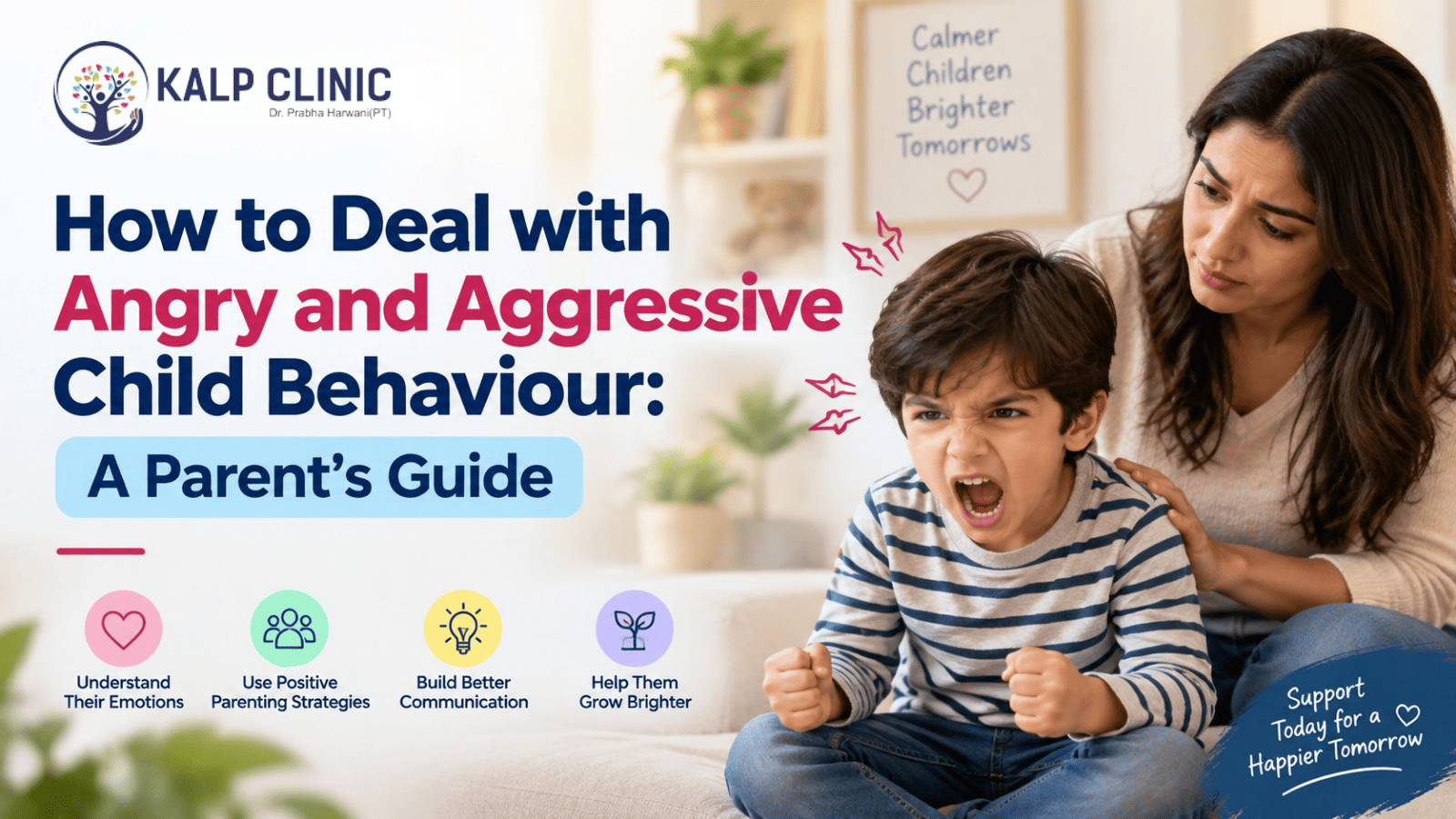
Every child becomes angry sometimes. Tantrums, shouting, refusing instructions, throwing objects, hitting, or pushing can happen when children are tired, frustrated, overwhelmed, unable to communicate their needs, or struggling with emotional regulation. However, when angry and aggressive child behaviour becomes frequent, intense, or starts affecting family life, school, friendships, or safety, parents may need professional guidance.
The goal is not simply to stop a child from becoming angry. Children need to learn how to understand emotions, communicate frustration, follow boundaries, solve problems, and respond safely.
Modern behavioural approaches increasingly focus on teaching children replacement skills rather than relying only on punishment. Recent evidence also supports parent-focused and multicomponent behavioural interventions for reducing disruptive behaviours in children.
At Kalp Clinic in Shyamal, Ahmedabad, Dr. Prabha Harwani(PT) – Paediatric Therapist, works with children and families to understand behavioural concerns and develop individualized strategies based on the child's developmental needs.
What Is Aggressive Behaviour in Children?
Aggressive behaviour can appear in different ways depending on the child's age and developmental stage.
Common examples include:
- Hitting, kicking, biting, or pushing
- Throwing toys or other objects
- Screaming or shouting frequently
- Breaking things intentionally
- Using threatening language
- Refusing instructions repeatedly
- Excessive tantrums
- Physical aggression toward parents, siblings, teachers, or peers
- Difficulty accepting "no"
- Becoming extremely upset when routines change
- Difficulty waiting, sharing, or taking turns
- Anger that seems much stronger than the situation requires
Occasional frustration is part of childhood development. Concern becomes greater when behaviour is persistent, excessive, unsafe, developmentally unusual, or interfering with daily life. The American Academy of Pediatrics notes that disruptive or aggressive behaviour should be considered in context, including possible sleep difficulties, learning challenges, emotional concerns, developmental factors, or stressful experiences.
Why Do Children Become Angry or Aggressive?
There is rarely one single reason for aggressive behaviour. A child's behaviour may be influenced by developmental, emotional, environmental, communication, or behavioural factors.
Possible triggers include:
1. Difficulty Communicating
Young children may know that something is wrong but lack the vocabulary to explain it. Instead of saying, "I am frustrated," they may scream, hit, or throw something.
2. Emotional Regulation Difficulties
Some children experience emotions very intensely and need additional support learning how to calm themselves.
3. Frustration and Unmet Expectations
Being told "no," losing a game, waiting for a turn, or having to stop a preferred activity can trigger strong reactions.
4. Changes in Routine
Unexpected changes, transitions, travel, school changes, or alterations to familiar routines may be difficult for some children.
5. Attention and Impulse-Control Difficulties
Children who struggle with impulsivity may act before thinking about the consequences.
6. Sleep, Hunger, or Overstimulation
Being tired, hungry, overwhelmed, or exposed to too much stimulation can make emotional regulation harder.
7. Learning or Developmental Challenges
Behaviour may sometimes be connected with communication difficulties, developmental differences, attention difficulties, or challenges with social interaction.
8. Environmental Stress
Family changes, school difficulties, peer problems, conflict, or other stressful experiences may affect a child's behaviour.
Understanding the reason behind the behaviour is an important part of creating an effective intervention.
Anger Is an Emotion — Aggression Is a Behaviour
One of the most important things parents can teach is that feeling angry is acceptable, but hurting people or damaging property is not.
For example:
- "It is okay to feel angry."
- "It is not okay to hit."
- "You can tell me that you are angry."
- "Let's find a safe way to calm down."
- "You can ask for help instead of throwing the toy."
This approach separates the child's emotional experience from the behaviour that needs to change.
The American Academy of Pediatrics recommends positive behavioural strategies, appropriate boundaries, positive reinforcement, and alternatives to physical punishment.
10 Practical Ways Parents Can Manage Aggressive Behaviour
1. Stay Calm During the Outburst
A child who is already emotionally overwhelmed may find it harder to calm down if adults shout or respond aggressively.
Try to:
- Use a calm voice.
- Keep instructions short.
- Reduce unnecessary talking.
- Give the child space when appropriate.
- Focus on safety first.
Your calm response can help demonstrate emotional regulation.
2. Set Clear and Consistent Boundaries
Children need to know what behaviour is acceptable.
Instead of saying:
"Don't behave badly!"
Try:
"Hands are for helping, not hitting."
Clear rules are easier for children to understand and remember.
3. Identify Triggers
Keep a simple behaviour diary for several days.
Record:
- What happened before the behaviour?
- What did the child do?
- What happened afterward?
- Was the child tired or hungry?
- Was there a transition?
- Was the child asked to stop a preferred activity?
- Did the behaviour result in attention or escape from a task?
Recognizing patterns can help parents and therapists identify triggers and appropriate strategies.
4. Teach Replacement Behaviours
Simply telling a child what not to do is often insufficient.
Teach what they can do instead.
For example:
Instead of hitting:
"Say, 'I am angry.'"
Instead of grabbing:
"Ask for a turn."
Instead of throwing:
"Put the toy down and ask for help."
Instead of screaming:
"Use a calm voice or show me what you need."
Behavioural intervention often focuses on strengthening useful alternative behaviours.
5. Praise Positive Behaviour Immediately
Children need to know when they are doing something successfully.
Specific praise can be more useful than general praise.
Instead of:
"Good boy!"
Try:
"I like how you waited for your turn."
Or:
"You were angry, but you used your words instead of hitting."
Positive parenting interventions commonly use reinforcement, modelling, psychoeducation, and individualized feedback to strengthen parenting practices and child outcomes.
6. Use Predictable Routines
A predictable daily schedule can help children understand what comes next.
Consider establishing regular times for:
- Waking up
- Meals
- School
- Homework
- Play
- Screen time
- Bathing
- Bedtime
When a transition is coming, provide advance notice:
"Five more minutes, then it will be time to stop playing."
7. Teach Emotional Vocabulary
Children who can identify emotions may gradually become better able to communicate them.
Teach words such as:
- Angry
- Sad
- Worried
- Frustrated
- Scared
- Disappointed
- Excited
- Overwhelmed
You can use storybooks, pictures, role-play, and everyday situations to practise identifying emotions.
8. Practise When the Child Is Calm
Do not wait until a major meltdown to teach coping strategies.
Practise during calm moments:
- Deep breathing
- Counting slowly
- Asking for help
- Taking a short break
- Using words to express feelings
- Moving to a quiet area
- Choosing between two acceptable options
9. Avoid Physical Punishment
Hitting, spanking, humiliating, or verbally shaming a child does not teach the emotional or communication skills they need.
The AAP recommends against corporal punishment and discipline that causes shame or humiliation.
10. Seek Professional Guidance When Needed
If aggressive behaviour is frequent, severe, worsening, or affecting the child's safety and development, professional assessment can help identify contributing factors and appropriate intervention.
What Is Behaviour Modification Therapy?
Behaviour Modification Therapy uses structured behavioural principles to help children develop appropriate behaviours and reduce behaviours that interfere with daily life.
A therapist may look at:
- What triggers the behaviour
- How the child responds
- What happens after the behaviour
- Communication abilities
- Emotional regulation
- Attention and motivation
- Family routines
- School or social situations
- Existing developmental concerns
The intervention can then focus on teaching practical replacement skills and reinforcing positive behaviour.
Recent pediatric guidance identifies parent management training as an evidence-based approach for younger children with externalizing behaviours. It can teach caregivers strategies for strengthening relationships, encouraging desirable behaviours, establishing healthy limits, and responding effectively to challenging behaviour.
What Happens During Behaviour Modification Therapy?
A child-focused behavioural program may include:
- Initial developmental and behavioural assessment
- Identification of specific target behaviours
- Understanding triggers and patterns
- Goal setting
- Positive reinforcement strategies
- Emotional regulation activities
- Communication and social-skills development
- Parent guidance
- Home-based strategies
- Progress monitoring
- Adjustments based on the child's response
Every child is different, so there is no single approach that works identically for every family.
How to Find the Best Behaviour Therapy for Children
Parents searching for the Best Behaviour therapy for children should look beyond advertisements and consider whether the service is appropriate for their child's specific needs.
Important questions to ask include:
- Does the therapist assess the child's individual needs?
- Is the treatment personalized?
- Are parents involved in the process?
- Are clear behavioural goals established?
- Is progress monitored?
- Does the therapist explain strategies that can be continued at home?
- Does the approach consider communication and developmental factors?
- Is the therapist experienced in working with children?
Evidence from a 2026 meta-analysis found that parent-only and multicomponent psychosocial interventions were associated with reductions in disruptive behaviour in preschool and school-aged children immediately after treatment, although outcomes varied and longer-term evidence was less consistent.
Searching for “Best Behaviour Modification Therapy Near Me”
Parents often search online for Best Behaviour Modification Therapy near me when aggressive behaviour starts affecting home or school life.
However, proximity should not be the only consideration.
When comparing child development and behavioural therapy options, consider:
- Therapist qualifications and experience
- Child-focused assessment
- Parent participation
- Individualized treatment planning
- Communication with families
- Progress tracking
- Accessibility for regular sessions
- Coordination with other professionals when required
For families in Ahmedabad, Kalp Clinic is located in Shyamal, making it accessible to parents looking for child development and behavioural support in the area.
When Should Parents Seek Professional Help?
Consider seeking professional guidance if your child's behaviour:
- Happens very frequently
- Is becoming more intense
- Causes injuries
- Includes repeated hitting, biting, kicking, or throwing
- Seriously affects school participation
- Creates significant family conflict
- Interferes with friendships
- Is difficult to manage despite consistent parenting strategies
- Appears alongside developmental or communication concerns
- Causes significant distress for the child or family
Professional assessment does not automatically mean that a child has a behavioural disorder. It can simply help parents understand why the behaviour is happening and what skills the child may need to develop.
Behaviour Modification Therapy at Kalp Clinic, Shyamal, Ahmedabad
At Kalp Clinic, behavioural concerns are approached from a child-development perspective. The focus is on understanding the child's needs and helping parents develop practical strategies for everyday situations.
Dr. Prabha Harwani(PT) – Paediatric Therapist provides child-focused support for developmental and behavioural concerns.
Families may seek professional guidance for concerns involving:
- Anger and aggression
- Frequent tantrums
- Emotional regulation
- Behavioural difficulties
- Communication-related frustration
- Attention and activity-related concerns
- Social interaction difficulties
- Autism-related behavioural challenges
- ADHD-related behavioural concerns
- Difficulty following instructions
- School-related behavioural concerns
Parents looking for a Best Child Development Center in Shyamal Ahmedabad can learn more about child development and therapy services at Kalp Clinic through www.kalpclinics.com.
A Parent's Role in Behaviour Change
Behavioural progress is not only about what happens inside a therapy session. What happens at home every day can also be important.
Parents can support progress by:
- Following agreed strategies consistently
- Using simple and clear instructions
- Praising appropriate behaviour
- Maintaining predictable routines
- Avoiding unnecessary arguments
- Giving children opportunities to make appropriate choices
- Practising emotional regulation skills
- Sharing observations with the therapist
- Celebrating small improvements
Recent research continues to examine the relationship between parenting behaviour, emotional regulation, and child aggression. A 2026 daily-diary study reported that days characterized by more positive parenting and closer mother-child relationships were associated with better emotion regulation and fewer reported aggressive behaviours in preschoolers.
Angry or aggressive behaviour does not automatically mean that a child is "bad" or that parents have failed. Behaviour is often a form of communication, particularly when children do not yet have the emotional, language, or self-regulation skills to express what they need.
The most useful goal is to understand the behaviour, maintain safe boundaries, teach appropriate alternatives, reinforce positive responses, and seek professional support when necessary.
With consistent guidance and developmentally appropriate strategies, children can gradually learn to recognize emotions, communicate frustration, manage impulses, solve problems, and interact more positively with others.
If your child is experiencing persistent anger, aggression, tantrums, or behavioural difficulties, consider discussing your concerns with a qualified child-development professional.
Kalp Clinic
Shyamal, Ahmedabad, Gujarat, India
Dr. Prabha Harwani(PT) – Paediatric Therapist
Website: www.kalpclinics.com
Frequently Asked Questions About Angry and Aggressive Child Behaviour
1. Why is my child becoming angry and aggressive so often?
Frequent anger or aggression can have different causes, including frustration, communication difficulties, emotional regulation challenges, impulsivity, changes in routine, sleep problems, learning difficulties, developmental concerns, or stressful situations. A professional assessment can help identify patterns and possible triggers.
2. What is Behaviour Modification Therapy for children?
Behaviour Modification Therapy is a structured approach that helps children learn appropriate behaviours and reduce behaviours that interfere with daily life. It may involve identifying triggers, teaching replacement skills, using positive reinforcement, establishing consistent boundaries, and involving parents in the intervention process.
3. What is the best Behaviour therapy for children?
There is no single therapy that is automatically best for every child. The appropriate approach depends on the child's age, developmental profile, communication abilities, behavioural patterns, family circumstances, and specific goals. Parent involvement and individualized planning are important components of many evidence-based behavioural approaches.
4. When should I search for Behaviour Modification Therapy near me?
Parents may consider professional support when aggressive behaviour is frequent, severe, difficult to manage, affecting school or relationships, or creating safety concerns. Early guidance can help families understand triggers and develop practical strategies before problems become more disruptive.
5. Can Behaviour Modification Therapy help with tantrums and anger?
Behavioural interventions can help children learn alternative ways to communicate needs, follow boundaries, manage frustration, and respond to challenging situations. The specific intervention should be individualized according to the child's developmental and behavioural needs.
6. Should parents punish an aggressive child?
Physical punishment and discipline involving shame or humiliation are not recommended. Instead, parents can use clear boundaries, calm responses, positive reinforcement, logical consequences, and opportunities to practise appropriate replacement behaviours.
7. Can screen time cause aggressive behaviour in children?
Screen use is only one potential factor among many. Parents should consider the child's overall routine, sleep, content consumed, family interactions, developmental needs, and what happens before and after behavioural episodes. If aggression is persistent, professional assessment can help identify the broader pattern.
8. Can ADHD or autism be related to aggressive behaviour?
Some children with ADHD, autism, communication difficulties, or other developmental differences may experience behavioural challenges, but aggression alone does not establish any diagnosis. A qualified professional should assess the child's complete developmental and behavioural profile.
9. How can parents calm an aggressive child during a meltdown?
First prioritize safety. Use a calm voice, reduce unnecessary demands, keep language simple, remove dangerous objects if necessary, and give the child time and space to regulate. Once the child is calm, discuss what happened and practise an alternative response.
10. Where can I find child behaviour therapy in Shyamal, Ahmedabad?
Families in Shyamal and surrounding Ahmedabad areas can explore child-development and behavioural support at Kalp Clinic, where Dr. Prabha Harwani(PT) – Paediatric Therapist provides child-focused developmental and therapy guidance. Visit www.kalpclinics.com for more information.