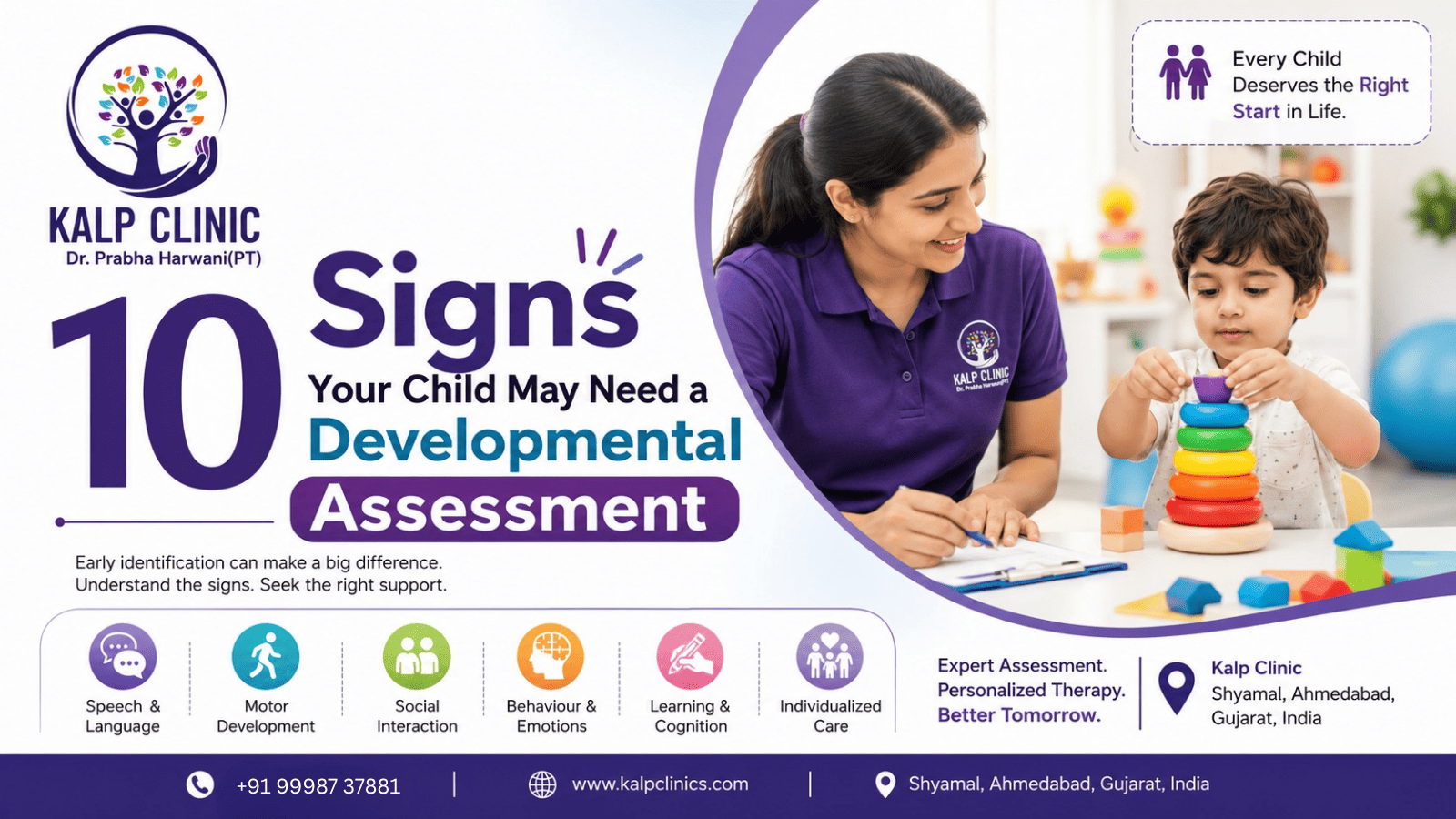
Every child grows and develops at their own pace. While some differences in development are completely normal, certain delays or challenges may indicate that a child could benefit from a professional developmental assessment. Recognizing these signs early allows parents to provide the right support at the right time, improving a child's ability to learn, communicate, move, and interact confidently.
At Kalp Clinic, under the expert guidance of Dr. Prabha Harwani (PT) – Paediatric Therapist, children receive comprehensive developmental assessments and individualized therapy plans based on their unique needs. Located in Shyamal, Ahmedabad, Gujarat, India, Kalp Clinic is committed to helping children reach their full potential through evidence-based paediatric rehabilitation services.
If you have noticed changes or delays in your child's development, this guide will help you understand the most common signs that should not be ignored.
What Is a Developmental Assessment?
A developmental assessment is a detailed evaluation of a child's overall growth across different developmental areas. It helps identify strengths, delays, and any challenges that may require early intervention.
A professional assessment generally evaluates:
- Gross motor skills
- Fine motor skills
- Speech and language
- Cognitive development
- Social interaction
- Emotional development
- Behaviour
- Learning abilities
- Sensory responses
- Daily living skills
The goal is not to label a child but to understand how they learn and develop so that appropriate support can be provided.
Why Early Developmental Assessment Matters
Early identification gives children the best opportunity to improve developmental skills before challenges become more significant.
Benefits include:
- Earlier intervention
- Improved communication
- Better academic readiness
- Enhanced social skills
- Greater independence
- Increased confidence
- Better long-term developmental outcomes
Parents often wait, hoping their child will "catch up." While some children naturally develop later than others, persistent delays should always be evaluated by an experienced paediatric therapist.
1. Delayed Speech and Language Development
One of the most common reasons parents seek professional advice is delayed speech.
Your child may need an assessment if they:
- Speak very few words for their age
- Have difficulty forming sentences
- Rarely respond when spoken to
- Struggle to understand simple instructions
- Have unclear speech after the expected developmental stage
- Use gestures more often than words
Speech delays may occur independently or alongside other developmental conditions.
Early evaluation helps identify the underlying cause and supports timely intervention.
2. Delayed Motor Milestones
Motor development includes activities such as rolling, sitting, crawling, standing, and walking.
Warning signs include:
- Late sitting without support
- Delayed crawling
- Difficulty standing
- Walking much later than expected
- Frequent falls
- Poor balance
- Difficulty climbing stairs
These signs may indicate the need for a professional assessment and Paediatric Physiotherapy.
3. Difficulty with Social Interaction
Children naturally develop social skills as they grow.
A developmental assessment may be helpful if your child:
- Avoids eye contact
- Prefers to play alone all the time
- Rarely smiles during interaction
- Does not respond to their name consistently
- Has difficulty making friends
- Shows limited interest in interactive games
Social development plays an important role in communication, emotional health, and school readiness.
4. Repetitive Behaviours or Restricted Interests
Some repetitive behaviours are common in young children, but persistent patterns may require evaluation.
Examples include:
- Repeated hand movements
- Constant spinning
- Lining up toys repeatedly
- Strong resistance to changes in routine
- Intense focus on a single object or activity
A developmental assessment can help determine whether these behaviours are age-appropriate or require further support.
5. Hyperactivity and Poor Attention
Every active child is not hyperactive, but persistent difficulty focusing may affect learning and daily life.
Common signs include:
- Constant movement
- Difficulty sitting still
- Easily distracted
- Frequently interrupting others
- Difficulty completing simple tasks
- Poor classroom attention
Professional evaluation helps identify the reason behind these behaviours and appropriate intervention strategies.
6. Difficulty Learning New Skills
Children learn differently, but ongoing struggles may indicate developmental concerns.
Signs include:
- Difficulty remembering instructions
- Slow learning compared to classmates
- Problems recognizing letters or numbers
- Poor problem-solving skills
- Difficulty following routines
- Challenges with school readiness
Early assessment helps create individualized learning support before academic difficulties become more significant.
7. Poor Coordination and Balance
Physical coordination affects everyday activities.
Watch for:
- Frequent tripping
- Poor balance
- Difficulty catching a ball
- Trouble jumping
- Weak posture
- Awkward walking pattern
These concerns may benefit from a detailed physical assessment and rehabilitation program.
8. Behavioural Challenges That Affect Daily Life
Occasional tantrums are part of childhood.
However, professional guidance may be needed if your child regularly experiences:
- Aggressive behaviour
- Severe frustration
- Emotional outbursts
- Difficulty adapting to change
- Frequent meltdowns
- Poor emotional regulation
Behavioural challenges should be understood rather than ignored, as they may reflect underlying developmental needs.
9. Difficulty with Fine Motor Skills
Fine motor skills involve small muscle movements required for everyday tasks.
Signs include:
- Difficulty holding crayons
- Trouble using scissors
- Poor handwriting
- Problems buttoning clothes
- Difficulty feeding independently
- Weak hand coordination
These skills are important for school performance and daily independence.
10. Parents Feel Something Isn't Right
Parents know their children better than anyone else.
Sometimes there may not be one obvious developmental delay, but you may notice:
- Your child is developing differently from siblings.
- Teachers express concerns.
- Relatives notice developmental differences.
- Daily tasks seem unusually difficult.
- Your child's progress has slowed.
If you feel concerned, trusting your instincts and seeking professional advice is always the right decision.
What Happens During a Developmental Assessment at Kalp Clinic?
At Kalp Clinic, assessments are designed to be child-friendly, comprehensive, and personalized.
The assessment process may include:
- Medical history review
- Developmental milestone evaluation
- Physical examination
- Movement assessment
- Speech and communication screening
- Behaviour observation
- Learning assessment
- Parent consultation
- Functional skill evaluation
Based on the findings, Dr. Prabha Harwani (PT) – Paediatric Therapist develops an individualized care plan tailored to the child's specific needs.
Conditions That May Benefit from Early Assessment
A developmental assessment can help identify or rule out concerns related to:
- Developmental delay
- Autism Spectrum Disorder (ASD)
- ADHD
- Speech delay
- Cerebral palsy
- Learning disabilities
- Sensory processing challenges
- Neurological disorders
- Behavioural concerns
- Motor coordination difficulties
Early identification allows therapy to begin before delays affect long-term development.
Therapy Services Available at Kalp Clinic
Depending on assessment findings, children may benefit from one or more specialized therapies.
Services include:
- Paediatric Physiotherapy
- Speech Therapy
- Oro Motor Therapy
- Behaviour Modification Therapy
- Autism Support Programs
- Paediatric Neurological Rehabilitation
- Special Education
- Remedial Education
- Parent Counselling
- Developmental Monitoring
Each therapy plan is customized according to the child's developmental goals rather than following a standard treatment approach.
How Parents Can Support Development at Home
Professional therapy is most effective when combined with consistent support at home.
Parents can help by:
- Reading with their child every day
- Encouraging active play
- Limiting excessive screen time
- Following daily routines
- Practicing therapy activities
- Encouraging communication
- Celebrating small achievements
- Maintaining regular follow-up appointments
Simple daily activities often contribute significantly to developmental progress.
Why Choose Kalp Clinic?
Families trust Kalp Clinic because of its child-focused and evidence-based approach to developmental care.
Why parents choose Kalp Clinic:
- Comprehensive developmental assessments
- Individualized treatment plans
- Experienced paediatric therapist
- Modern therapy techniques
- Family-centred care
- Child-friendly environment
- Regular progress monitoring
- Personalized parent guidance
- Multidisciplinary rehabilitation services
Located in Shyamal, Ahmedabad, Kalp Clinic supports children from infancy through school age with compassionate and professional care.
When Should You Book an Assessment?
You do not need to wait for a formal diagnosis before seeking professional advice.
Consider scheduling a developmental assessment if:
- Developmental milestones seem delayed.
- Teachers recommend an evaluation.
- Your child struggles socially.
- Speech development is slower than expected.
- Behaviour affects learning or family life.
- You simply have concerns about your child's development.
Early consultation provides clarity, reassurance, and a plan for moving forward.
Every child deserves the opportunity to thrive. While developmental differences are common, recognizing the early signs of delay and seeking timely support can make a meaningful difference in a child's future. A professional developmental assessment helps identify areas where a child may need guidance and opens the door to personalized intervention that supports long-term growth.
At Kalp Clinic, Dr. Prabha Harwani (PT) – Paediatric Therapist is dedicated to helping children build stronger physical, communication, behavioural, and learning skills through comprehensive assessments and individualized therapy programs. Whether your child is experiencing speech delays, motor challenges, behavioural concerns, or learning difficulties, early evaluation can be the first step toward achieving their full potential.
If you are looking for a trusted child development clinic in Shyamal, Ahmedabad, visit Kalp Clinic to learn how early assessment and specialized therapy can support your child's developmental journey.